Almost Turkish Recipes

Showing posts with label vegan. Show all posts

Bean Salad (Piyaz)


Piyaz comes from the Persian word for onion, but in Turkish cuisine, it has taken on a life of its own. Today, it refers either to a bean salad made with onions, parsley, olive oil and vinegar, spiced with red pepper flakes, and adorned with tomatoes, parsley, sumac, and slices of hard-boiled egg. Regional variations abound: some add green onions, while in Antalyatahini gives piyaz its signature twist. 

In my hometown of Tekirdağ, one of Turkiye's two meatball capitals, piyaz is inseparable from kofte,  meatballs. One simply cannot be served without the other. But hınestly, piyaz goes with everything: grilled meat, warm bread, rice. One of  my favorite lunches is a bowl of cold rice and piyaz. 
Ingredients
  • 2 cups cannellini beans, soaked overnight and cooked until soft OR 1 can of cannellini beans, rinsed and drained
  • 1 small red onion, thinly sliced in half moons, kneaded with 1tsp of salt, then rinsed and drained
  • 1 tomato, diced (in Turkey tomatoes are always peeled before being added to salads)
  • 1 green pepper, thinly sliced (shishito peppers make a great substitute for Turkish green chilies)
  • 1/3 cup parsley, finely chopped
  • 1-2 tsp sumac
  • 1 tsp hot pepper flakes (optional)
  • a few black olives, pitted for garnish
optional but traditional
  • 1 hard-boiled egg, chopped (I personally don't understand the appeal of rock-hard, bland eggs, especially cold ones. So I skip this part. But if your like them, go for it) 

for the dressing
  • 1/4 cup (or a bit more) good olive oil
  • 2-3 tbsp apple or white wine vinegar
  • salt, to taste
instructions
-Arrange the beans on a flat oval or rectangle serving plate (not too deep.)
-Layer the kneaded and rinsed onions on top.
-Scatter the diced tomatoes and sliced green peppers. if using eggs, add them now.
-Sprinkle with sumac and hot pepper flakes.
-Top with chopped parsley and a few black olives for decoration.
-In a small bowl, whisk together the olive oil, vinegar and salt. Tast it, the dressing should be distincly tangy. Piyaz should be a bit sour. Vinegar should definitely come through!
-Pour the dressing evenly over the salad. 
-Mix well right at the table before eating, and dig in, preferably with a crusty piece of bread!


Turkish-Style Romano Beans in Olive Oil (Zeytinyağlı Taze Fasulye)


Now that summer's in full swing, the farmers' markets are bursting with fresh Romano beans--the broad, flat Italian kind. They're almost identical to Turkish çalı fasülye, the star of many summer lunches and dinners back home. You'll find them served cold as a meze, or as a light main dish alongside rice. 

The trick is to cook them as soon as you bring them home. If you must wait, they'll keep in the fridge for up to a week. After that, they start turning woody and lose their sweet green flavor, which is no good for this kind of dish. 

No Romano beans? No problem. French beans (haricots verts) will work just fine: see this recipe

  • 1 lb fresh Romano beans, washed and trimmed (snap off the ends and strip any stringy sides), then sliced lengthwise and cut into 2-3 inch (about 5 cm) pieces. 
  • 1 medium onion, finely chopped
  • 2-3 cloves of garlic, sliced or chopped
  • 2 big or 4 medium fresh tomatoes, finely diced, grated, or blended--or just blend a can of diced tomatoes for a smoother shortcut
  • 1/2 tsp ground cumin
  • 1/3 cup olive oil, plus 2 tbsp more for a final drizzle
  • ~1 cup hot water
  • salt, to taste
Cooking:
-Heat the olive oil in a heavy-bottomed pot (or pressure cooker if you're in a hurry). Add the chopped onion and sauté over medium heat until soft and translucent, about 7 minutes. No browning!
-Stir in the garlic and cook for just a minute, until it smells amazing. Again, don't let it brown or burn.
-Add the green beans and cumin. Stir everything together and cook for 4-6 minutes, until the beans brighten and lose that raw green look.
-Add the grated/blended tomatoes, stir and cook for 3-5 minutes.
-Pour in enough hot water to just barely cover the beans, no bean soup here. Add salt to taste. 
-Cover and simmer gently on low to low medium heat for 25-30 minutes, until the beans are soft and silky. 
-If using a pressure cooker: Lock the lid and cook for 12-14 minutes after it reaches pressure.

Whatever pot you use, let the beans cool in it, don't rush them into another container while they're hot. These Turkish olive oil dishes are better as they sit and settle.

Serve at room temperature, drizzled with a little extra olive oil. 

This dish is great with buttery rice, a thick dollop of yogurt, or just a nice piece of crusty bread. In my family, it's rice and yogurt every time. 


Cretan Style Zucchini Ribbons with Rice (Girit Usulü Kabak Sıyırma)


This Cretan style zucchini dish/meze is an absolute summer favorite. Cretans create magic with zucchinis and this one is no exception. 

3 medium sized zucchinis, peeled and ribboned. Do not ribbon the soft, seedy inside, just the firm flesh. Save the seedy cores for mucver  (we don't want the skin since it might have a different cooking time compared to the flesh of the zucchini)  

1/4 cup baldo, arborio, if not jasmine rice, soaked in hot water for at least 20 minutes

3-4 green onions, finely chopped

3 cloves of garlic, thinly sliced

~1/4 cup fresh dill, finely chopped

~1/4 or less fresh mint, finely chopped

1/2 cup olive oil 

juice of one lemon

salt


 -Put 1/4 cup of rice i hot water to soak.

-Peel and ribbon the zucchini. Sprinkle some salt on top and leave to rest. 

-In a pot heat the half of the olive oil, ~1/4 cup, and add the green onions. Cook for 2-3 minutes.

-Rinse the rice after at least 20 minutes in hot water, and add to the pot. 

It is important to soak the rice in hot water, DO NOT skip this step. We need to cut the cooking time for rice so the zucchini doesn't melt away while rice is cooking. 

-Add garlic with the rice. 

-Cook for 3 minutes stirring constantly. 

-Add 1/2 cup of water and let cook covered on low to medium for ~10 minutes. Check every now and then for water. 

-After 10 minutes, the rice should be half way cooked. Add zucchini ribbons, lemon juice and some salt. Stir and cook for another 10 minutes covered. No extra water needed since the zucchini will release some of its own.

-After ten minutes the both the rice and zucchini will be cooked. We don't want zucchini to be too soft. 

-Turn it off, add half of dill and mint, stir and let it cool down to room temperature. 

-Serve it on a wide round or oval dish. Pour the rest of the olive oil on top and sprinkle the rest of the fresh herbes. Salt to your taste. It is good at room temperature or cold. It is a great dish for hot summer days but also an excellent meze/side. You can enjoy it with a slice o f good bread or with cold yogurt. Bon appétit! 

Mushroom and Green Olive Salad (Yeşil Zeytinli Mantar Salatası)


Back in the day when I used to live in Ankara, on my way home I used to stop by a well-known supermarket right by my house for its extensive salad bar; and the mushroom and olive salad was my favorite. I had it as a side for dinner or on its own for lunch. With all the fresh herbes and acidity coming from green olives and pickles, it clicked all the right boxes for my sour loving taste buds. I learned some tips on how to make it from the supermarket chef and since then it's been a staple for me. 

Nothing is set here; you can use more or less of any ingredient.

for 4 as a side/ for 2 as a main dish

2 cups of sliced mushroom
1 cup of sliced pitted green olives, not the canned olives
1/2 cup corn
1/2 cup finely chopped pickles
1-2 red sweet pepper, finely chopped
4 green onions, finely chopped
1/3 cup fresh parsley, finely chopped
1/4 cup fresh dill, finely chopped
1/8 cup fresh mint, finely chopped
juice of 1 lemon
3-4 tbsp olive oil
2 tbsp balsamic vinegar
salt 

-Mix 3 cups of water and juice of half lemon in a saucepan and boil the chopped mushrooms for 5 minutes. (lemon juice will prevent the mushroom from darkening, so you need to put the mushrooms in the lemony water as you chop) Drain well and let cool down.
-Mix everything in a bowl.
-Salt to your taste and add other half of the lemon juice and olive oil. 
-Drizzle the balsamic vinegar on top and serve. 
It goes well as a side for grilled meat or veggies or as a lunch on its own.  


Sautéed Spicy Beet Greens


Beet greens, stems and leaves, although usually discarded, are in fact quite healthy, sweet, and delicious when cooked in simple ways. There are a couple of different ways of cooking beet greens in Turkish cuisine. The following recipe is a simple one rice and olive oil.

We get beets, red or golden, from the csa farm box almost every week and absolutely love to use them to pickle or for salads and risottos. I save the greens for my lunch.  I love sauteing them a couple of different ways like this recipe, but this spicy one with jalapenos is my favorite. 


beet greens of 1 bunch red or golden beet, stems and leaves chopped
1 small onion, finely chopped
2 cloves of garlic, minced
1 or more jalapenos or any hot pepper of your liking, finely chopped
2-3 tbsp olive oil
Salt and pepper
Red pepper flakes    


-Heat olive oil in a pot.
-Add onion and cook on medium 3-4 minutes until soft.
-Add beet stems, jalapeno, and garlic. Sauté another 3 minutes.
-Add chopped leaves, salt and pepper and keep sauteing on low to medium for ~10 minutes. 
-Salt and pepper to taste. Add hot pepper flakes if you wish.
-Serve at room temperature or cold, preferably with yogurt on top, and baguette on the side. Sprinkle with red pepper flakes and Tabasco sauce for more fun!

Green Lentil Salad (Yeşil Mercimek Salatası)


If you are a lentil lover, this could be one the most delicious and nutritious salads. While studying for my qualifying exams at the library all day as a graduate student, green lentil salad was my lunch for at least three days a week. 

There's nothing written in stone: You can use more or less of anything down below. In Turkey this salad is usually dressed with pomegranate molasses, however I don't enjoy the slight sweetness that comes with it, so I prefer crisp tartness of lemons. 

For 4 people
1 cup green lentils
4-5 scallions, finely chopped
2-3 red sweet Italian peppers, finely chopped
1/2 cup roasted red peppers, chopped
1/2 cup dill or cucumber pickles, or cornichon pickles finely chopped
1/2 cup or a bit more canned corn 
1/3 cup fresh dill, finely chopped
1/3 cup fresh parsley, finely chopped
1/4 cup fresh mint, finely chopped

salt
juice of 1 lemon
a generous 1/4 cup of olive oil

optional
2-3 tbsp pomegranate molasses (It's widely available at international or middle eastern stores)
1/4 cup pickled jalapenos, finely chopped (I absolutely love having pickled jalapenos in this salad, sour and spicy is a perfect combination)
1/4 cup pickled peppers, finely chopped
1/3 - 1/2 cup crumbled feta

-Put 1 cup green lentils in a pot with 4-5 cups of water and cook for ~15 minutes. Check to see if they're cooked after 1o minutes. Lentils should be cooked but not mushy. Immediately rinse in a colander or sieve; we don't want the lentil to cook more in the hot water. 1 cup will make a lot of lentils, perfect for company or lunch for everyday.
-Chop everythıng finely as if you're trying to match them with lentils. 
-Salt to your taste. 
-Add juice of one lemon. One lemon is usually good for this many lentils but you can use less as well. I usually add a bit more. (If you would like to add pomegranate molasses balance it with lemon juice) 
-Add olive oil and toss.  
Enjoy!


Antalya Bean Salad (Antalya Usulü Piyaz)

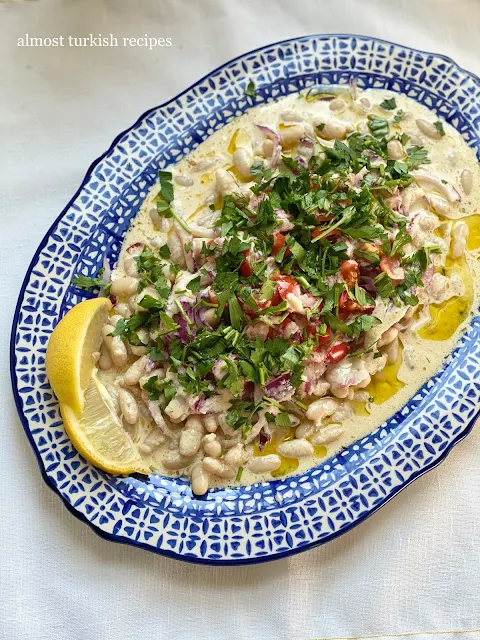
Piyaz is what we call bean salads in Turkey, but the term is actually Persian and means "onion." Piyaz is usually prepared with cannellini beans and kneaded onion; dressed with olive oil and vinegar; spiced up with pepper flakes; and decorated with tomatoes, parsley, and hard-boiled eggs. Depending on the region, piyaz might have green onions or sumac. However, in Antalya, a beautiful city with magnificent beaches and  rich history on the Mediterranean coast, piyaz is made differently than the rest of Turkey. The difference is tahini and garlic, which had put me off at my first try because it was so different and incredibly rich than the piyazs I was used to. In Tekirdag, my hometown, and in Antalya piyaz is usually served with grilled meatballs. 

I've had different versions of Antalya bean salad in years. Sometimes the difference is how it's served; with or without onions, sometimes it's the beans; sometimes the beans are served warm and sometimes at room temperature; and sometimes it's the sauce; some add smashed or pureed beans to the sauce, some add a little bit of sugar to level the tahini, and some add cumin, which I liked a lot. This is how I make my Antalya bean salad at home to go with grilled meatballs.  

2 cups of cooked cannellini beans (save the cooking water)
1 small onion, cut finely in julienne or half-moons (in Antalya, they serve the onion diced, but I prefer julienne)
1/2 cup parsley, finely chopped
1 or two hard boiled eggs, sliced or grated (I don't like eating cold eggs, so I skip this one)
1 tomato, peeled if you feel like it and diced


the sauce
1/2 cup tahini
4 tbsp vinegar, red wine or apple
Juice of half a lemon 
2 cloves of garlic, minced
1/4 - 1/3 cup olive oil
1tsp salt
1/2 tsp ground cumin, if you want to try it with cumin 


-Soak the beans overnight. Bring them to a boil and then on medium heat cook them until soft but never mushy, they should be holding themselves fine. Save the cooking water. OR, ofcourse, use canned beans.
-In a bowl mix first tahini and vinegar to a smooth consistency. It will get clumpy; it's fine, it will loosen up. Just keep stirring. 
-Add minced garlic, salt, and garlic. If the sauce is thick, this is where we will add the cooking water from beans, a couple of tablespoons at a time, slowly. Use a whisk to get rid of clumps. Add water until you have a smooth tahini sauce, but not very runny. The tahini sauce shouldn't be too runny or thick. Since different tahini brands have different density, I cannot tell you exactly how many tablespoons of water you need. Finally add lemon juice and half of the olive oil and whisk again. 
-First place the beans on a plate (I like the warm bean version so I keep the beans in the pot until I serve them to keep them warm). In Turkey piyaz is usually served on oval, slightly deep serving platters so you have enough sauce to dip your crusty bread in.
-Slice the onion thinly julienne style and knead with 1 tsp salt in a bowl. Rinse and squeeze the excess water and place on the bean. 
-Add diced tomatoes on top.
-This is where that boiled egg will come. You can add the egg chopped or grated on top. 
-Pour the tahini dressing over everything on the plate evenly.
-Sprinkle finely chopped parsley on top of everything.
-Finally, dress with the rest of the olive oil and serve with a lemon slice or half a lemon on the side, because there's no such thing as piyaz being "too sour."  Piyaz is usually tossed at the table and you have to, have to soak that juice with bread! 


Vegetarian and Minty Cannellini Beans (Zeytinyağlı Naneli Kuru Fasulye)


Cannellini beans, referred to as dry beans or simply as 'the dry,' along with rice is THE traditional Turkish dish. If there's pickled vegetables on the side, especially cabbage, voila, jackpot!  There are variations of this recipe based on what kind of meat you want to use, or although rare, a vegetarian version. You can cook dry cannellinis  with stew beef or lamb, with ground meat-my least favorite, pastrami (pastirma)-yumm, and/or soujuk (sucuk, Middle Eastern/Turkish sausage). 

Although traditionally the dish has meat in it, growing up in my house we loved the 'olive oil! i.e. the vegetarian version the best, especially during summers. Mom's vegetarian summer version has no meat but sweet green chilies, fresh mint leaves, and sun dried tomatoes. Delicious! 


For 4 people
2 cups soaked cannellini beans (1 cup soaked overnight makes ~2 cups) or 2 cans of cannellini beans [Although the taste will be different, you can use northern or navy beans as well]
1 medium onion, finely chopped
2 cloves of garlic, chopped finely
2-3 sweet green chilies or any peppers you like or can fine, chopped 
1/3 cup fresh mint leaves, finely chopped or 1-1 1/2 tbsp dry mint leaves
1/3 cup or more sun dried tomatoes, chopped
1 tbsp tomato paste
1 tomato, grated or canned petite diced tomato
salt 
3-4 tbsp olive oil

-Put olive oil in a cast iron pot and heat [You can use any kind of pot, but beans are cooked best in cast irons or clay pots]
-Add onion and cook ~5 minutes until soft but not brown.
-Add green peppers and cook 2-3 minutes.
-Add garlic and tomato paste. Cook for 2 minutes. 
-Add beans, sun dried tomatoes, fresh or dry mint leaves, and grated tomato. Cook for 2 minutes.
-Add water to go almost an inch over the beans. Salt to your taste.
-Bring to a boil and then simmer covered on low to medium for 30-40 minutes. If you're using canned beans 30 minutes will be enough. If you soaked the beans overnight, check the beans after 40 minutes; they may need a good hour or bit more. 
-Enjoy with rice or any kind of grain on the side or crusty bread to soak that delicious tomato juice. Yogurt and pickled veggies on the side are most beloved sides for dry beans. 


Oven-Baked Vegetarian Stuffed Red Bell Peppers (Fırında Zeytinyağlı Kırmızı Biber Dolması)


Dolmas, stuffed bell peppers, in Turkey are almost exclusively green; however, the green bell peppers there are tiny and beautifully thin, that's perfect for stuffing. I never even attempt to stuff green bell peppers in US. Now and again I come across at farmers' markets and at grocery stores smaller bell peppers, usually red or purple, and I immediately jump over them with joy. I especially like the red ones, because the sweetness from the red bell pepper comes out beeautıfully when baked. These peppers are approximately as big as my fist.  

This recipe is for 8 bell peppers

8 bell peppers
1 big onion, ~1 1/2 cups finely chopped (you can use a food processor)
1 1/2 cups white rice
1 big or two medium tomatoes, grated
1 tomato (this one is for covering the tops of bell peppers after stuffing)
1/4 - 1/3 cup pine nuts (I love them so I go for 1/3) 
1/4 cup currants (most people who are not fond of sweet in their food skip this ingredient) 
1 tbsp allspice
1 tsp ground black pepper
1 tbsp mint flakes or ¼ cup fresh mint, chopped finely
1 tsp white sugar
salt
juice of 1/2 lemon
2 cups boiling water


-Wash all the bell peppers. Take out the top part and the seeds. With a tip of a sharp knife pierce them at the bottom once or twice. (Save the tops if you want to cover your dolmas as the one in the picture. If you prefer to have tomato covers as in the first picture, discard the tops. Tomato covers keep the dolmas more juicy and the pepper tops look very cute) 
-Mix all the ingredients except for peppers, one tomato that we will use as a cover, and water. 
-Stuff the peppers with the stuffing rice. Don’t go all the way up to the top, leave almost 3/4 inch to an inch, because the rice will cook and rise. 
-Cut big enough rounds from the tomato the cover the tops. Press the tomato slice down a bit to ensure that it'll stay there. (If you opt to use the tops, do the same)
-Place the dolmas in a stove and oven safe dish or pot as high as them. 
-Pour 2 cups of boiling hot water. 
-First bring to a boil on the stove and cook for 5 minutes and then bake in the oven uncovered at 390-400 F for 35-40 minutes, until rice is cooked. (If you're not sure, check the rice with a fork). I really like my oven-baked dolmas to be charred on top just a bit so I make sure they do. They're delicious that way. 
-Take them out and let them cool down to room temperature. Oven-baked vegetarian dolmas, just like all other Turkish olive oil dishes, are best when eaten at room temperature and the day after they're made. 
Enjoy with yogurt on the side!    

Purslane with Rice (Pirinçli Semizotu)


Long before Dr Mehmet Öz, aka Dr. Oz, started to appear on morning shows on Turkish TV channels and regularly on Oprah to talk about healthy eating habits with a great emphasis on purslane (surprisingly rich in Omega 3 fatty acids), the weed frequented Turkish tables in dishes and salads all summer long. If Dr. Oz's advice on healthy food triggered interest in purslane in Turkey, it also caused inflation in purslane prices. A couple of summers ago on questioning a sudden increase of purslane prices, just out of pure curiosity not by any reluctance to pay, I was almost scolded by a vendor at my hometown's farmer's market back in Turkey: "Mam, even Dr. Mehmet Öz appreciates purslane, why don't you?" I always have and especially do now here in the States, where it's relatively harder to find it. We're lucky here in Northern California that purslane is available at farmer's markets.   Sometimes it is called purslane and sometimes it is called in its Spanish name "verdolaga."  Purslane is a weed and can easily grow anywhere under any condition. If you can get our hands on purslane seeds, do plant them and you won't regret. 


~1 lb purslane (aka verdolaga)
1 medium onion, finely chopped (
2 cloves of garlic, minced
2 tbsp rice or bulgur or quinoa 
3 tbsp olive oil
1 tsp salt
1 tsp black pepper
juice of half lemon
1/3 cup water

optional
1 jalapeno, finely chopped
or 2 tsp crushed spicy peppers 


-Wash purslane well and chop it into 1-1 1/2 inch pieces. You don't need to discard the stems.
-Heat olive oil in a wide pot. Stir in onion and garlic. Cook until soft, 3-4 minutes.
-If you're spicing your purslane up with mighty jalapenos or some other hot peppers add them now and cook for 1-2 minutes. 
-Add purslane/verdolaga. Stir a couple of times until wilted.
-Add lemon juice, salt, pepper, and water.
-When it starts boiling, add rice (or whatever grain you're using but make sure it's something that wouldn't take too long to cook such as brown rice) and turn the heat down to low.
-Cover and simmer until rice is cooked.
-Serve warm or cold with garlicy yogurt (for garlicy yogurt mix 1 clove of minced garlic per 1 cup of yogurt with a dash of salt) on the side.


ps: if you are not very enthusiastic about green leafy vegetables, there's big chance you won't like purslane with its crunchy stems and tangy taste.

Shepherd's Salad (Çoban Salatası)


Shepherd’s salad (çoban salatası inTurkish) is the unchallenged center food of Turkish summer tables. When you go to köfte/kebab or a small scale neighborhood restaurant the waiter would bring this salad with water, ordering not necessary. Shepherd’s salad is made with easily accessible, summer’s usual suspects that even a shepherd can have tending their herd out in the country, i.e., tomatoes, peppers, cucumbers, onions, and parsley. Although these five are invariable (despite heated arguments over whether a “true” shepherd’s salad would have cucumber or not), there are also variations of this fresh summer salad, much to the purists’ dismay! Some add pitted black olives; some cannot have it without crumbled white cheese on top; and some add red peppers or some greens like arugula. Dressing is also quite simple: lemon juice or vinegar or both, olive oil and salt.


The most valuable part of this salad is the juice that sits at the bottom: olive oil and vinegar/lemon juice mixed with juice oozing from the fresh tomatoes and flavored with onions, peppers and parsley. It is customary to peel the tomatoes for maximum juice. And you have to have that bread! You have to soak that juice and finish the plate clean with who-knows-how-many morsels of bread. I’ve loved putting scoops of this salad on my plain rice as a kid and I still to this day love mixing my rice with shepherd’s salad. However, other people usually enjoy shepherd’s salad with grilled meats and veggies or basically anything. On really hot and humid summer nights shepherd’s salad along with slices of watermelon and white cheese makes the best dinner. The most loved shepherd’s salads are those chopped finely.


For 4 people
2 big or 4 medium size tomatoes, peeled if you bother and petite diced
2-3 green peppers, shishito peppers or sweet Italian peppers are good for this, thinly chopped
2 Persian cucumbers, peeled or not, quartered lengthwise and thinly chopped
1 small onion, preferably red for flavor, thinly chopped in half moon shapes, kneaded for a minute with ½ tsp salt and rinsed well
¼ bunch flat leaf parsley, finely chopped
1 lemon and/or 2 tbsp vinegar, apple, white or red wine


Optional
Crumbled feta
Pitted Turkish black olives (Kalamata is fine but please never canned olives)

-Start chopping all and layering them in a slightly deep serving dish in this order: tomatoes, cucumbers, peppers, onions, (cheese and olives) and lastly parsley. You have to knead the onion with salt and rinse it. You cannot miss this step since it’ll take the bitterness and crunchiness of the onions.
-Salt to your taste, ½ to 1 tsp salt.
-Add juice of half lemon (this depends on how juicy our lemon is. You might need juice of a whole lemon) or 1-2 tbsp vinegar. Some people like it with lemon juice whereas some like it with vinegar. I like them both and sometimes get acidity from both for my salad.
-Add 4-6 tbsp olive oil. In Turkey 4 would be on the stingy side. We’re very generous with our good olive oil when it comes to shepherd’s salad. You can think as 1-1,5 tbsp olive oil per person.
-Mix everything well and dig in!

Fava Bean and Pea Salad (İç Bakla ve Bezelye Salatası)


A timely, deliciously green olive oil dish or salad for spring when both fresh fava beans and peas start to appear at farmers' markets.

1 small onion, finely diced
1 clove of garlic, minced or finely chopped
1 lb fresh fava beans in pod (or frozen podded favas)
1/2 lb fresh peas in pod or frozen peas
3 green onions, finely chopped
~1/4 cup finely chopped fresh mint leaves
~1/4 cup finely chopped fresh dill
1/4 cup + 2 tbsp olive oil

1/2 tsp white sugar
juice of half a lemon

~1/3 cup crumbled feta (optional)
dressing


-Pod and boil fava beans in salted water for 5 minutes. The cooking time depends on the freshness of the beans. Blanch and poke the skin to squeeze the beans out. This is time consuming, yet makes a salad better. Some people find fava skins to be bitter, I don't. If anything skins make the salad a bit chewy and that is fine. I sometimes leave the skins on and sometimes, when I'm not in a rush, peel them.
-Heat a pot on medium, add 1/4 olive oil. When heated add onions. Cook onions on low to medium, do not brown them, until soft: 5-7 minutes.
-Add sugar, half of the chopped green onions, fava beans, and podded fresh or frozen green peas, and garlic, salt.  
-Cover and simmer on low for 15-20 minutes.
-Turn it off, add lemon juice, half of dill and mint and let cool down to room temperature in the pot, covered.
-Take the favas out on a serving plate. Sprinkle with the remaining green onion, dill and mint.
-Drizzle 2 tbsp of olive oil and serve at room temperature.

There's absolutely nothing written in stone; you can use more or less of anything, or add other herbs that you think would suit the favas and peas. I like sprinkling some white/feta cheese on top. 

Potato Salad à la Turca (Patates Salatası)

https://drive.google.com/uc?export=view&id=1grSd9b2XK7LPle_kQW_udqGDdj-I7btd
Potato salad, I had to say à la Turque not to have it confused with any of its American or European cousins, is an herbed filled, green heavy savory deliciousness. It is a great side when grilling and the absolute perfect lunch on summer days. The history of this salad in Turkish cuisine is vague and it is made in differing variations across Turkey. Although potato salad is in all its variations usually prepared as quite savory and herby, it is rarely as herby as the one I make. This salad can be one of my earliest specialties as I started making at at the age of 10. My rule is any herb and any Mediterranean green can and must go into this salad. There's nothing written in stone here; you have your boiled potatoes and herbs on them. However, the Turkish potato salad has to be savory and a bit on the sour side.

Potatoes enough to make 4-5 cups when chopped--in Turkey this is made with yellow potatoes since we don't have red ones over there; however, I love it with red potatoes,too.
1 small onion
1/2 bunch green onions, chopped
1 cucumber, cut in quarter rounds
3 banana peppers (or any other green/red pepper), chopped finely
1/4 cups halved and pitted green olives
1/4 cups finely chopped dill pickles or capers
1/2 bunch parsley, chopped
1/4 cup dill, chopped
1/4 cup fresh mint, chopped or 2 tsp dried mint flakes
1/2 tsp spicy red crushed pepper (optional)
1 tsp sweet paprika
1 tsp sumac 
1/2 tsp black pepper
juice of one and a half lemons (check after one to see if it's sour enough for you. I usually end of using almost 2 lemon for their juice, but I do love sour)
1/3-1/2 cup olive oil, you will be surprised how much olive oil this salad can need and hide
1-2 tbsp dijon mustard (optional)
salt

-Either boil the potatoes (however much you will be using) as a whole in plenty of water until soft but not mushy, very important! You want the potatoes to hold their shapes. Then peel and dice them. (InTurkey potatoes are always peeled, but in Turkey potatoes usually come with a big chunk of the field they were planted in. I don't think the ones you find here in US need peeling. I prefer not peeling them) If you're short for time, peel (optional, again) and dice first and then boil them--this way they will be ready much faster, approximately 10 minutes. Drain and let cool
-Cut the onion in half lengthwise and then chop it into very thin half moons. Put the chopped onion in a bowl and knead it with 1 tsp salt until the onion is soft. Rinse the salt off the onion and drain. 
-Mix olive oil, salt, and lemon juice (and mustard if you choose to use it--it contributes to the savory taste in a magnificent way.)
-Mix all the other ingredients and potatoes in a big bowl. 
-Dress and mix well. Make necessary adjustments: olive oil, salt or more lemon juice. 

Serve as an appetizer, salad, as a side dish for meat or enjoy it as lunch on a hot summer day. 

Leeks in Olive Oil (Zeytinyağlı Pırasa)


In Turkish cuisine, most "pırasa" dishes, originally praso from Greek, are attributed to Albanian Turks. Not only leeks feature predominantly in Albanian immigrants' dishes, but also they make, hands down, the best leek dishes. The Albanian börek (phyllo pastry) with leeks is just to die for. Although leeks have a milder flavor with a sweet touch than its relatives onions and garlic, for some it is still quite overwhelming. So in Turkey you either love them or not at all, a well known fact that seems to have inspired Baba Zula, a Turkish alternative music band, to compose a song called pırasa the lyrics of which goes: "There are two different kinds of people in this world: those who love leeks, and those who don't.... those who don't know how to love leeks and then those who can love them" This is the recipe that turned me into one of those who know how to enjoy leeks!


for 4 people
4 regular leeks or 2 King leeks, really hard top dark green parts discarded, washed well and chopped in 1/3 inch rounds
1 small onion, finely chopped
2 carrots, chopped in rounds or half moons
1/4 cup or a handful of rice
1/3 cup olive oil
Juice of one lemon
2/3 - 1 cup hot water, to cover the leeks
1 tsp sugar
Salt

-Heat olive oil in a pot on medium and add onions, cook until soft but NOT brown. This is an olive oil dish and having browned onions in olive oil dishes changes the taste completely.
-Add carrots and sugar, stir for 3 more minutes
-Add leeks and stir for a couple of minutes until wilted
-Add rice and cook for a minute.
-Add lemon juice, salt and water to barely cover the leeks.
-Cover and cook on low heat until rice is cooked, approximately 20-25 minutes.
-Let the leeks cool down to room temperature in its own pot, lid closed.
-Transfer to a serving plate and serve at room temperature or cold.
-In Turkey 1=2 tbsp olive oils is scattered on top of the leeks on the serving plate to have a shinier look.

Usually when leeks are served, sliced lemons would be available on the table for extra drops of fresh lemon juice on top. It brings up the flavors beautifully. Eat with a nice loaf of bread. I love eating them mostly for lunch with yogurt on the side.

Green Lentils (Yeşil Mercimek)


The eastern Thrace is the north western or the European part of Turkey. The region (except for Istanbul) is mostly occupied by people who migrated from the western Thrace (Greece and Bulgaria). Most of those people, like my grandparents, settled down in the region after the 1924 population exchange. This green lentil dish is cooked widely in eastern Thrace and known to be a western Thracian recipe.

1 cup dry green lentils
3 tbsp olive oil or butter
1 big onion, chopped
1 tbsp flour
2 tbsp tomato paste
salt
pepper
2 tbsp fresh dill, chopped

sauce
1/4 cup vinegar
2 cloves of garlic, minced
1 tsp red pepper flakes
or
use a vinegar based hot sauce


-Cook 1 cup green lentils with 3 cups of water on medium until water is completely soaked.
-In a different pot heat the oil and stir in onions. Cook until soft.
-Add flour and stir for a couple of minutes.
-Add tomato paste and stir for another couple of minutes.
-Add lentils with 2 1/2 cups of water. Salt to your taste. Cook on medium low for 30 minutes. -Add dill after you turn it off.
-For the sauce, in a little bowl mix 1/4 cup vinegar, 2 cloves of minced garlic, and crushed pepper.
-When you serve the lentils, put a couple of spoons of the sauce on lentils.
-Serve with bread or rice.

Tomato-Carrot Soup (Domatesli Havuç Çorbası)


I have young and quite picky clientele at home for whom I have to cook and not disclose my ingredients. This, of course, is not easy with many dishes, but soups are great for food plotting. For years in our house soups were classified by their color; green soup (yayla soup), pink soup (beet soup), yellow soup (simply red lentil soup), etc. Tomato-carrot soup was known to them as orange soup and to me as "salvage-mushy-tomatoes" soup: whenever tomatoes get too soft to enjoy at breakfast or in salads, I throw them in the freezer and when I have approximately 2 cups worth of tomatoes I make this soup. This simple soup is one of our family favorites. I made this for my mom and some of my Turkish aunties back in Turkey and they all asked for the recipe and that's when you know it is a damn good soup!


serves 4-5 people
2 cups of fresh tomatoes (roughly chopped-if you're using cherry tomatoes leave them as is) or 1 can diced tomatoes
2 medium orange carrots
1 whole red bell pepper, roughly chopped or 6-7 red or orange sweet Italian peppers, seeded
1 medium onion, roughly chopped
3 garlic cloves
1 bay leaf
3-4 tbsp olive oil
salt & pepper to taste

optional
1 cup milk or heavy cream or coconut milk
or chicken broth

-Heat a heavy bottom pot or you soup pot and add oil.
-When oil is hot add onions and red peppers with the bay leaf. Stir on medium (if it's a cast iron pot) or high (if you're using a stainless steel pot) until soft, ~5 minutes.
-Add carrots and garlic. Stir until vegetables start to brown on the edges and caramalize, ~10 minutes.
-Add tomatoes and cook for another 5 minutes, until fresh tomatoes change color. 
-Add 5 cups of water or broth of your choice. 
-Salt to your taste and simmer on low for 15-20 minutes, until carrots are cooked. 
-Take the bay leaf out and with a hand blender smoothen the soup. 
-Enjoy with a slice of toast on the side and crumbled feta on top. 
    If you want to twist it around, add just 4 cups of water or stock and after blending the soup add a cup of milk, heavy cream or coconut cream, whichever flavor you fancy. 


Simply Red Lentil Soup (Sadece Kırmızı Mercimek Çorbası)

Red lentils might be the most preferred and loved ingredient for soups in Turkish cuisine. There are multiple variations of the staple red lentil soup such as the restaurant style red lentil soup that uses flour for thickening, ezo gelin soup, red lentil soup with carrots and potatoes, or red lentil soup with some sort of grain. Among all my favorite one is the simply red lentil soup that my mom makes all the time. It's made simply with red lentils and almost nothing else.


2 cups of red lentils
1 small onion halved
1 tbsp olive oil
salt
5 cups of water (You can use vegetable or chicken stock as well)

optional
1 tsp peppercorns
1-2 bay leaves


-Wash red lentils with plenty of water
-Heat olive oil in a pot. Add lentils, onion and if you're using bay leaves and peppercorns. Stir until red lentils turn slightly yellow.
-While stirring lentils, boil 5 cups of water.
-Once the lentils start to get yellowish, add water and simmer on medium to low.
-In 15-20 minutes, lentils will lose their shape and color to turn into this yellowish beautiful soup.
-Add salt and serve with a slice of lemon (and spicy pepper flakes)

Red Lentil and Beet Soup (Kırmızı Mercimekli Pancar Çorbası)

This deliciously colorful and healthy soup is known simply as the "pink" soup in our house, since I prefer not to disclose to my young and picky eaters all the vegetables that goes in this soup: ignorance is bliss sometimes. This red lentil and beet soup is a staple in our house. Beets go into the soup and beet greens into this recipe.


2 small to medium size beets, peeled and diced (If bought in a bunch, use stems and leaves as well, chopped)
1 small red onion, chopped
3 cloves of garlic
1/2 cup red lentils, washed
1 to 1 1/2 cups of chopped fresh tomatoes or 1 can diced tomato
1 red bell pepper or 3 red sweet Italian peppers, chopped
4-5 cups of water (or vegetable or chicken stock)
2 tbsp olive oil
1 bay leaf
salt and pepper

for decoration
White/feta cheese
parsley, finely chopped

-Put all the ingredients in a big pot and bring to boil.
-Once it boils, turn the heat down and simmer approximately for 20 minutes or until everything is thoroughly cooked.
-Smoothen the soup with a hand blender. (If you don't have a hand blender, chop everything tiny or grate everything before adding them into the pot.)
-Optional: Serve with chopped parsley and white cheese on top (I also like to add a dollop of yogurt) and/or white crusty bread.