Almost Turkish Recipes

Showing posts with label salads/sides/mezes. Show all posts

Bean Salad (Piyaz)


Piyaz comes from the Persian word for onion, but in Turkish cuisine, it has taken on a life of its own. Today, it refers either to a bean salad made with onions, parsley, olive oil and vinegar, spiced with red pepper flakes, and adorned with tomatoes, parsley, sumac, and slices of hard-boiled egg. Regional variations abound: some add green onions, while in Antalyatahini gives piyaz its signature twist. 

In my hometown of Tekirdağ, one of Turkiye's two meatball capitals, piyaz is inseparable from kofte,  meatballs. One simply cannot be served without the other. But hınestly, piyaz goes with everything: grilled meat, warm bread, rice. One of  my favorite lunches is a bowl of cold rice and piyaz. 
Ingredients
  • 2 cups cannellini beans, soaked overnight and cooked until soft OR 1 can of cannellini beans, rinsed and drained
  • 1 small red onion, thinly sliced in half moons, kneaded with 1tsp of salt, then rinsed and drained
  • 1 tomato, diced (in Turkey tomatoes are always peeled before being added to salads)
  • 1 green pepper, thinly sliced (shishito peppers make a great substitute for Turkish green chilies)
  • 1/3 cup parsley, finely chopped
  • 1-2 tsp sumac
  • 1 tsp hot pepper flakes (optional)
  • a few black olives, pitted for garnish
optional but traditional
  • 1 hard-boiled egg, chopped (I personally don't understand the appeal of rock-hard, bland eggs, especially cold ones. So I skip this part. But if your like them, go for it) 

for the dressing
  • 1/4 cup (or a bit more) good olive oil
  • 2-3 tbsp apple or white wine vinegar
  • salt, to taste
instructions
-Arrange the beans on a flat oval or rectangle serving plate (not too deep.)
-Layer the kneaded and rinsed onions on top.
-Scatter the diced tomatoes and sliced green peppers. if using eggs, add them now.
-Sprinkle with sumac and hot pepper flakes.
-Top with chopped parsley and a few black olives for decoration.
-In a small bowl, whisk together the olive oil, vinegar and salt. Tast it, the dressing should be distincly tangy. Piyaz should be a bit sour. Vinegar should definitely come through!
-Pour the dressing evenly over the salad. 
-Mix well right at the table before eating, and dig in, preferably with a crusty piece of bread!


Crispy Okra (Çıtır Bamya Mezesi)


Years and years ago when we moved to the south for a couple of years, I decided to give fried okra a chance,  despite it being my least favorite vegetable. To my surprise it turned out to be a rather enlightening moment. I discovered when prepared this way okra becomes quite palatable and even makes for an excellent meze. Through some experimentation, I found that crispy okra, especially when served on garlicy yogurt, is the best. 

Nothing is set in stone here. Feel free to adjust any of the ingredients to your liking or based on your needs. 


~1/2 lb or less fresh okra pods, sliced

1-2 tbsp olive oil

~3 tbsp cornmeal

1 cup yogurt

1 clove of garlic, minced

optional: 1 tbsp fresh dill, finely chopped

1 tbsp olive oil + 1 tsp paprika or crushed hot pepper flakes


-Coat the sliced okras with olive oil in a bowl. Once they're coated, add cornmeal and coat them with cornmeal as well.
-Arrange the sliced okras in a single layer on a parchment lined baking tray and bake at 430F preheated oven for ~20 minutes or until crispy. 
-Mix one cup of yogurt with one clove of minced garlic and a dash of salt. Cover the bottom of a plate with yogurt. Top it with crispy okras. 
-In a small frying pan, heat 1 to 2 tablespoons of olive oil and add either paprika or, if you want spicy, crushed pepper flakes. Drizzle it on top of okras and yogurt.
_Sprinkle some fresh dill and serve. 

Bon appétit! 


Haydari Yogurt Dip/Side


Haydari, a sine qua non for rakı tables, is a perfect summer side dish or dip. It is great with grilled meat or on toasted bread. Traditionally it's made by mixing strained/Greek yogurt and white cheese--although some try to skip the cheese, we all know that it ain't haydari if there's no cheese. 

~2 cup strained or Greek yogurt (in Turkey it's always whole milk yogurt, but non-fat is also fine)
1/2 cup Turkish or Bulgarian white cheese. If you cannot find them, use feta. 
1 clove of garlic, minced
2-3 tsp dry mint leaves 
1/4 cup fresh dill, chopped
2 tbsp butter
2 tbsp olive oil
salt

-With a mortar and pestle mash the white cheese to a smooth texture. You can use the back of a fork as well but make sure there are absolutely no lumps left. 
-Mix the cheese and yogurt, and half of the fresh dill, and salt in a bowl. The amount of salt depends on the saltiness of the cheese. Adjust to your taste. 
-In a small pan heat 2 tbsp butter,1 tbsp olive oil, and garlic. 
-When the butter starts bubbling. Turn the heat off and add the dry mint. Set aside to cool down to room temperature. 
-Once the butter cools down, mix it into the yogurt. Mix it really well.
!!!Once you mix the butter into the yogurt, haydari should never go into the fridge, should stay out at room temperature.!!!
-Serving: Haydari is best served on an oval or rectangle serving plate. Lay it evenly on the plate and then make dents with the side edge of the scoop for olive oil that we'll use to decorate to stay on,  as in the picture. 
-Drizzle the remaining olive oil and sprinkle the rest of the fresh dill.
Bon appétit!

Peppers with Cheese (Lorlu Biber)


A great Thracian specialty! Just like menemen, peppers with cheese can also be served as a side dish, main dish, or a breakfast treat. Many people enjoy lorlu biber for breakfast or lunch, but in my family we usually have it for dinner with fresh bread. it's really easy to make, and almost impossible to go wrong.

For this recipe you can use as many peppers and as much cheese as you want; as you can see in the first picture I love mine quite cheesy. Traditionally lorlu biber is made with long green peppers called çarliston, i.e.  Charleston yet no idea why this name. However, there ares so many different kinds of delicious peppers out there shishitoes, sweet Italian, Hungarian, poblanos, banana peppers, just follow your taste buds. 

1 lb green/red/orange/yellow peppers, chopped in rounds (seeds taken out)
1/2 cup ricotta, cottage, or farmers cheese (this can easily go up to 1 full cup)
2-3 tbsp olive oil
salt if needed


-Heat oil in a frying pan.
-When it's really hot, add chopped peppers and saute until they get slightly brown
-Take the peppers out with a slotted spoon and place them on a paper towel to soak excessive oil.
-Add cheese.
-Stir until cheese starts melting.
-Serve hot. 

Mushroom and Green Olive Salad (Yeşil Zeytinli Mantar Salatası)


Back in the day when I used to live in Ankara, on my way home I used to stop by a well-known supermarket right by my house for its extensive salad bar; and the mushroom and olive salad was my favorite. I had it as a side for dinner or on its own for lunch. With all the fresh herbes and acidity coming from green olives and pickles, it clicked all the right boxes for my sour loving taste buds. I learned some tips on how to make it from the supermarket chef and since then it's been a staple for me. 

Nothing is set here; you can use more or less of any ingredient.

for 4 as a side/ for 2 as a main dish

2 cups of sliced mushroom
1 cup of sliced pitted green olives, not the canned olives
1/2 cup corn
1/2 cup finely chopped pickles
1-2 red sweet pepper, finely chopped
4 green onions, finely chopped
1/3 cup fresh parsley, finely chopped
1/4 cup fresh dill, finely chopped
1/8 cup fresh mint, finely chopped
juice of 1 lemon
3-4 tbsp olive oil
2 tbsp balsamic vinegar
salt 

-Mix 3 cups of water and juice of half lemon in a saucepan and boil the chopped mushrooms for 5 minutes. (lemon juice will prevent the mushroom from darkening, so you need to put the mushrooms in the lemony water as you chop) Drain well and let cool down.
-Mix everything in a bowl.
-Salt to your taste and add other half of the lemon juice and olive oil. 
-Drizzle the balsamic vinegar on top and serve. 
It goes well as a side for grilled meat or veggies or as a lunch on its own.  


Green Lentil Salad (Yeşil Mercimek Salatası)


If you are a lentil lover, this could be one the most delicious and nutritious salads. While studying for my qualifying exams at the library all day as a graduate student, green lentil salad was my lunch for at least three days a week. 

There's nothing written in stone: You can use more or less of anything down below. In Turkey this salad is usually dressed with pomegranate molasses, however I don't enjoy the slight sweetness that comes with it, so I prefer crisp tartness of lemons. 

For 4 people
1 cup green lentils
4-5 scallions, finely chopped
2-3 red sweet Italian peppers, finely chopped
1/2 cup roasted red peppers, chopped
1/2 cup dill or cucumber pickles, or cornichon pickles finely chopped
1/2 cup or a bit more canned corn 
1/3 cup fresh dill, finely chopped
1/3 cup fresh parsley, finely chopped
1/4 cup fresh mint, finely chopped

salt
juice of 1 lemon
a generous 1/4 cup of olive oil

optional
2-3 tbsp pomegranate molasses (It's widely available at international or middle eastern stores)
1/4 cup pickled jalapenos, finely chopped (I absolutely love having pickled jalapenos in this salad, sour and spicy is a perfect combination)
1/4 cup pickled peppers, finely chopped
1/3 - 1/2 cup crumbled feta

-Put 1 cup green lentils in a pot with 4-5 cups of water and cook for ~15 minutes. Check to see if they're cooked after 1o minutes. Lentils should be cooked but not mushy. Immediately rinse in a colander or sieve; we don't want the lentil to cook more in the hot water. 1 cup will make a lot of lentils, perfect for company or lunch for everyday.
-Chop everythıng finely as if you're trying to match them with lentils. 
-Salt to your taste. 
-Add juice of one lemon. One lemon is usually good for this many lentils but you can use less as well. I usually add a bit more. (If you would like to add pomegranate molasses balance it with lemon juice) 
-Add olive oil and toss.  
Enjoy!


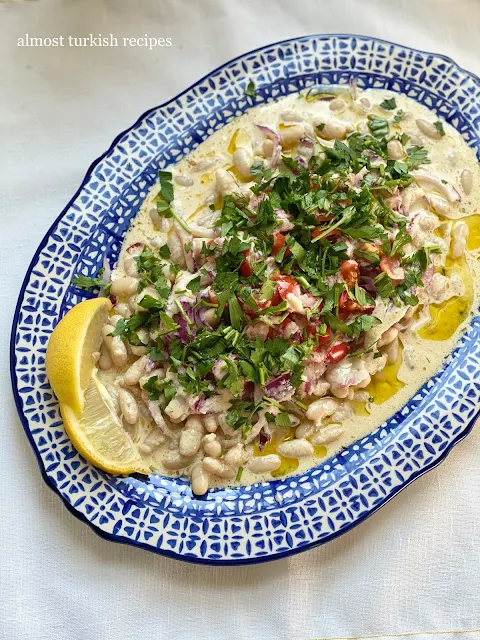
Antalya Bean Salad (Antalya Usulü Piyaz)

Piyaz is what we call bean salads in Turkey, but the term is actually Persian and means "onion." Piyaz is usually prepared with cannellini beans and kneaded onion; dressed with olive oil and vinegar; spiced up with pepper flakes; and decorated with tomatoes, parsley, and hard-boiled eggs. Depending on the region, piyaz might have green onions or sumac. However, in Antalya, a beautiful city with magnificent beaches and  rich history on the Mediterranean coast, piyaz is made differently than the rest of Turkey. The difference is tahini and garlic, which had put me off at my first try because it was so different and incredibly rich than the piyazs I was used to. In Tekirdag, my hometown, and in Antalya piyaz is usually served with grilled meatballs. 

I've had different versions of Antalya bean salad in years. Sometimes the difference is how it's served; with or without onions, sometimes it's the beans; sometimes the beans are served warm and sometimes at room temperature; and sometimes it's the sauce; some add smashed or pureed beans to the sauce, some add a little bit of sugar to level the tahini, and some add cumin, which I liked a lot. This is how I make my Antalya bean salad at home to go with grilled meatballs.  

2 cups of cooked cannellini beans (save the cooking water)
1 small onion, cut finely in julienne or half-moons (in Antalya, they serve the onion diced, but I prefer julienne)
1/2 cup parsley, finely chopped
1 or two hard boiled eggs, sliced or grated (I don't like eating cold eggs, so I skip this one)
1 tomato, peeled if you feel like it and diced


the sauce
1/2 cup tahini
4 tbsp vinegar, red wine or apple
Juice of half a lemon 
2 cloves of garlic, minced
1/4 - 1/3 cup olive oil
1tsp salt
1/2 tsp ground cumin, if you want to try it with cumin 


-Soak the beans overnight. Bring them to a boil and then on medium heat cook them until soft but never mushy, they should be holding themselves fine. Save the cooking water. OR, ofcourse, use canned beans.
-In a bowl mix first tahini and vinegar to a smooth consistency. It will get clumpy; it's fine, it will loosen up. Just keep stirring. 
-Add minced garlic, salt, and garlic. If the sauce is thick, this is where we will add the cooking water from beans, a couple of tablespoons at a time, slowly. Use a whisk to get rid of clumps. Add water until you have a smooth tahini sauce, but not very runny. The tahini sauce shouldn't be too runny or thick. Since different tahini brands have different density, I cannot tell you exactly how many tablespoons of water you need. Finally add lemon juice and half of the olive oil and whisk again. 
-First place the beans on a plate (I like the warm bean version so I keep the beans in the pot until I serve them to keep them warm). In Turkey piyaz is usually served on oval, slightly deep serving platters so you have enough sauce to dip your crusty bread in.
-Slice the onion thinly julienne style and knead with 1 tsp salt in a bowl. Rinse and squeeze the excess water and place on the bean. 
-Add diced tomatoes on top.
-This is where that boiled egg will come. You can add the egg chopped or grated on top. 
-Pour the tahini dressing over everything on the plate evenly.
-Sprinkle finely chopped parsley on top of everything.
-Finally, dress with the rest of the olive oil and serve with a lemon slice or half a lemon on the side, because there's no such thing as piyaz being "too sour."  Piyaz is usually tossed at the table and you have to, have to soak that juice with bread! 


Fried Eggplant or Eggplant as Fake Fish (Patlıcan Balığı)


When I saw this particular fried eggplant dish, originally called "eggplant fish" in Turkish,  for the first time on the menu of a cute small tavern in an Aegean town, I snubbed. Why would I ever want to eat an eggplant that pretends to be a fish in Aegean, i.e. fish paradise. The owner/chef talked us into. I was wrong. It was great.

The eggplant fish is a beloved tavern meze/side dish. It is served in different shapes; sometimes the whole eggplant is flattened like a fish filet or sometimes cut in stripes as I did. In Turkey it is usually served in meyhanes/taverns on the side of raki but I do love it with cold beer as well. 


sevres 2

1 American eggplant, peeled and cut in long sticks
1 egg
1 cup corn flour
1 cup or more frying oil (I use sunflower oil) 
1-2 tsp salt

-Boil water with 1 tsp salt in a big pot.
-While it's heating up, wash and peel your eggplant(s)
-Beat one egg (or more if you're using more than one eggplant) in a wide bottom bowl.
-And in another bowl or plate mix corn flour or cornmeal with 1-1,5 tsp salt. 
-When the water is boiling place eggplant sticks in batches and boil for 4-5 minutes.
-Drain eggplants, cover thoroughly first with egg and then with corn flour. 
-Heat frying oil. And fry eggplants sticks or eggplant fish until golden brown. 
-Serve with garlicy yogurt on the side. (For garlicy yogurt mix one minced clove of garlic with one to two cups of yogurt.) 


Shepherd's Salad (Çoban Salatası)


Shepherd’s salad (çoban salatası inTurkish) is the unchallenged center food of Turkish summer tables. When you go to köfte/kebab or a small scale neighborhood restaurant the waiter would bring this salad with water, ordering not necessary. Shepherd’s salad is made with easily accessible, summer’s usual suspects that even a shepherd can have tending their herd out in the country, i.e., tomatoes, peppers, cucumbers, onions, and parsley. Although these five are invariable (despite heated arguments over whether a “true” shepherd’s salad would have cucumber or not), there are also variations of this fresh summer salad, much to the purists’ dismay! Some add pitted black olives; some cannot have it without crumbled white cheese on top; and some add red peppers or some greens like arugula. Dressing is also quite simple: lemon juice or vinegar or both, olive oil and salt.


The most valuable part of this salad is the juice that sits at the bottom: olive oil and vinegar/lemon juice mixed with juice oozing from the fresh tomatoes and flavored with onions, peppers and parsley. It is customary to peel the tomatoes for maximum juice. And you have to have that bread! You have to soak that juice and finish the plate clean with who-knows-how-many morsels of bread. I’ve loved putting scoops of this salad on my plain rice as a kid and I still to this day love mixing my rice with shepherd’s salad. However, other people usually enjoy shepherd’s salad with grilled meats and veggies or basically anything. On really hot and humid summer nights shepherd’s salad along with slices of watermelon and white cheese makes the best dinner. The most loved shepherd’s salads are those chopped finely.


For 4 people
2 big or 4 medium size tomatoes, peeled if you bother and petite diced
2-3 green peppers, shishito peppers or sweet Italian peppers are good for this, thinly chopped
2 Persian cucumbers, peeled or not, quartered lengthwise and thinly chopped
1 small onion, preferably red for flavor, thinly chopped in half moon shapes, kneaded for a minute with ½ tsp salt and rinsed well
¼ bunch flat leaf parsley, finely chopped
1 lemon and/or 2 tbsp vinegar, apple, white or red wine


Optional
Crumbled feta
Pitted Turkish black olives (Kalamata is fine but please never canned olives)

-Start chopping all and layering them in a slightly deep serving dish in this order: tomatoes, cucumbers, peppers, onions, (cheese and olives) and lastly parsley. You have to knead the onion with salt and rinse it. You cannot miss this step since it’ll take the bitterness and crunchiness of the onions.
-Salt to your taste, ½ to 1 tsp salt.
-Add juice of half lemon (this depends on how juicy our lemon is. You might need juice of a whole lemon) or 1-2 tbsp vinegar. Some people like it with lemon juice whereas some like it with vinegar. I like them both and sometimes get acidity from both for my salad.
-Add 4-6 tbsp olive oil. In Turkey 4 would be on the stingy side. We’re very generous with our good olive oil when it comes to shepherd’s salad. You can think as 1-1,5 tbsp olive oil per person.
-Mix everything well and dig in!

Fava Bean and Pea Salad (İç Bakla ve Bezelye Salatası)


A timely, deliciously green olive oil dish or salad for spring when both fresh fava beans and peas start to appear at farmers' markets.

1 small onion, finely diced
1 clove of garlic, minced or finely chopped
1 lb fresh fava beans in pod (or frozen podded favas)
1/2 lb fresh peas in pod or frozen peas
3 green onions, finely chopped
~1/4 cup finely chopped fresh mint leaves
~1/4 cup finely chopped fresh dill
1/4 cup + 2 tbsp olive oil

1/2 tsp white sugar
juice of half a lemon

~1/3 cup crumbled feta (optional)
dressing


-Pod and boil fava beans in salted water for 5 minutes. The cooking time depends on the freshness of the beans. Blanch and poke the skin to squeeze the beans out. This is time consuming, yet makes a salad better. Some people find fava skins to be bitter, I don't. If anything skins make the salad a bit chewy and that is fine. I sometimes leave the skins on and sometimes, when I'm not in a rush, peel them.
-Heat a pot on medium, add 1/4 olive oil. When heated add onions. Cook onions on low to medium, do not brown them, until soft: 5-7 minutes.
-Add sugar, half of the chopped green onions, fava beans, and podded fresh or frozen green peas, and garlic, salt.  
-Cover and simmer on low for 15-20 minutes.
-Turn it off, add lemon juice, half of dill and mint and let cool down to room temperature in the pot, covered.
-Take the favas out on a serving plate. Sprinkle with the remaining green onion, dill and mint.
-Drizzle 2 tbsp of olive oil and serve at room temperature.

There's absolutely nothing written in stone; you can use more or less of anything, or add other herbs that you think would suit the favas and peas. I like sprinkling some white/feta cheese on top. 

Potato Salad à la Turca (Patates Salatası)

https://drive.google.com/uc?export=view&id=1grSd9b2XK7LPle_kQW_udqGDdj-I7btd
Potato salad, I had to say à la Turque not to have it confused with any of its American or European cousins, is an herbed filled, green heavy savory deliciousness. It is a great side when grilling and the absolute perfect lunch on summer days. The history of this salad in Turkish cuisine is vague and it is made in differing variations across Turkey. Although potato salad is in all its variations usually prepared as quite savory and herby, it is rarely as herby as the one I make. This salad can be one of my earliest specialties as I started making at at the age of 10. My rule is any herb and any Mediterranean green can and must go into this salad. There's nothing written in stone here; you have your boiled potatoes and herbs on them. However, the Turkish potato salad has to be savory and a bit on the sour side.

Potatoes enough to make 4-5 cups when chopped--in Turkey this is made with yellow potatoes since we don't have red ones over there; however, I love it with red potatoes,too.
1 small onion
1/2 bunch green onions, chopped
1 cucumber, cut in quarter rounds
3 banana peppers (or any other green/red pepper), chopped finely
1/4 cups halved and pitted green olives
1/4 cups finely chopped dill pickles or capers
1/2 bunch parsley, chopped
1/4 cup dill, chopped
1/4 cup fresh mint, chopped or 2 tsp dried mint flakes
1/2 tsp spicy red crushed pepper (optional)
1 tsp sweet paprika
1 tsp sumac 
1/2 tsp black pepper
juice of one and a half lemons (check after one to see if it's sour enough for you. I usually end of using almost 2 lemon for their juice, but I do love sour)
1/3-1/2 cup olive oil, you will be surprised how much olive oil this salad can need and hide
1-2 tbsp dijon mustard (optional)
salt

-Either boil the potatoes (however much you will be using) as a whole in plenty of water until soft but not mushy, very important! You want the potatoes to hold their shapes. Then peel and dice them. (InTurkey potatoes are always peeled, but in Turkey potatoes usually come with a big chunk of the field they were planted in. I don't think the ones you find here in US need peeling. I prefer not peeling them) If you're short for time, peel (optional, again) and dice first and then boil them--this way they will be ready much faster, approximately 10 minutes. Drain and let cool
-Cut the onion in half lengthwise and then chop it into very thin half moons. Put the chopped onion in a bowl and knead it with 1 tsp salt until the onion is soft. Rinse the salt off the onion and drain. 
-Mix olive oil, salt, and lemon juice (and mustard if you choose to use it--it contributes to the savory taste in a magnificent way.)
-Mix all the other ingredients and potatoes in a big bowl. 
-Dress and mix well. Make necessary adjustments: olive oil, salt or more lemon juice. 

Serve as an appetizer, salad, as a side dish for meat or enjoy it as lunch on a hot summer day. 

Carrot Salad with Yogurt (Yoğurtlu Havuç Salatası)


Carrot salad with yogurt is one of the greatly respected rakı companions. Although it is made at homes not so frequently, usually for big dinner parties or special occasions like New Year's eve or bayram dinners, it is a  staple meze (appetizer/starter/hors d'oeuvre) at every pub that serves rakı, especially at seafood pubs. Surprisingly carrot salad with yogurt tastes even better at sloppy pubs with crusty bread and rakı than it does at home, probably because rakı fixes every imperfection. You can have this salad/meze on the side of any grilled goods or have it on its own for lunch on hot summer days.


serves 2 to 3 people
4 cups of grated carrot
1 cup plain yogurt, preferably whole milk yogurt
1-2 cloves of garlic, minced
2 tbsp olive oil
3-4 tbsp finely chopped fresh dill or parsley
salt
1 tbsp mayonnaise (optional)

-Heat oil in a skillet and add grated carrots. Stir until carrots are wilted.
-Mix yogurt, garlic, and salt in a bowl.
-Put carrots in a bowl and mix well with yogurt and sprinkle with dill or parsley.

note: At people's houses this meze is made with yogurt, but at pubs they sometimes use mayonnaise to thicken it up.

Thracian Roasted Eggplant Salad (Tunçilik)


During summer months roasted eggplant salads are very common in Thrace, where my hometown is. Thrace (Trakya in Turkish) is the northwestern corner or the European part of Turkey. Thrace is a historical and geographical region that spreads over Greece, Bulgaria, and Turkey. The Turkish part is the Eastern Thrace. Eastern Thrace, in years, witnessed major waves of migration, population exchanges--like the two big ones after the Ottoman-Russian war and the Lausanne Treaty--which created the marvelous ethnic, cultural, and culinary mosaic of the region today.

My favorite jewel of this culinary mosaic, Tunçilik, is one of the many different versions of roasted eggplant salads or mezes (=appetizer) that's made in the region. Tunçilik is a specialty of the southwestern part of Turkish Thrace around Tekirdağ.


for 6 people
4 eggplants
5-6 mild green peppers (New Mexico Hatch, shishito, banana, Anaheim, or even poblano) or red peppers,
2 tomatoes, finely chopped
4 cloves of garlic, minced
6-7 tbsp of vinegar
3-4 tbsp olive oil
salt
1/2 bunch parsley, finely chopped
There's nothing written in stone. You can use more or less of everything listed up here. Whatever you do, make sure you use all the ingredients. There's no such thing as Tunçilik without parsley, peppers, or tomatoes, or vinegar. Make it less vinegary or more oily or peppery, but have all the ingredients.


-Roast eggplants and peppers on a grill until soft and charred, or in an oven at 450 Fahrenheit. Roast tomatoes along with eggplants and peppers for 4-5 minutes.
-Let them cool first. If you cover them with a paper bag or place them in a paper bag, they will sweat and peel much more easily. Then peel eggplants, peppers, and tomatoes. And seed them. (I leave some charred skin on for extra smoky flavor)
-Chopped them all finely.
-In a bowl place chopped eggplants, peppers, tomatoes, and parsley.
-In a small bowl, mix crushed garlic, vinegar, olive oil, and salt. Add this on vegetables.
-Mix well. Taste. If you think you can handle a little more garlic and vinegar, do not hesitate to add more.
-Tunçilik goes well with  grilled red meat/poultry or vegetables or with any kind of grain. And do not forget to soak the juice with a slice of good and preferably crusty bread.

Zucchini Salad with Yogurt (Yoğurtlu Kabak Salatası)


Zucchini salad with yogurt is a favorite summer time cold delicacy. It is served as a side dish at afternoon tea gatherings along with any kind of pogacas or filo dough pastries, or as a meze/appetizer at dinner. You can serve it with grilled meat or simply as a side to anything you want. I love this salad as lunch on toasted bread and sometimes with crumbled white cheese/feta on top. It is quite easy and quick to make and simply delicious. Even those who do not like zucchini enjoy this salad. In Turkish cuisine to have a zucchini dish without fresh dill or mint is unheard-of. For this salad it's common to use both fresh mint and dill. If you do not like one of them you can leave that one out, but only one. Zucchini salad has to have at least one fresh herb.

serves 4
3 medium size zucchini, coarsely grated (makes approximately 3 cups)
2/3 cup thick plain yogurt )enough to barely cover zucchini, not much)
1 1/2 tbsp olive oil
1-2 cloves of minced garlic, depending on how much you like garlic
1/2 cup crushed walnuts
1/8 cup or as much as you want fresh dill, finely chopped
1 tsp mint flakes or 1 tbsp fresh mint, finely chopped
salt

optional
1 tsp crushed red pepper flakes

-Grate zucchinis in a bowl. Squeeze grated zucchini by hand and drain excessive juice.
-Heat olive oil in a pan. Add zucchini and cook for 5-6 minutes or until wılted and tender stirring occasionally. Set aside to cool down.
-Mix yogurt, minced garlic and a pinch of salt well in a bowl.
-When zucchini cools down, mix zucchini, walnuts, dill, mint, salt, and the garlicy yogurt.
-Serve cold.

Roasted Beet Hummus (Pancarlı Humus)


In my first couple of years in the US, I couldn’t get over how popular hummus was in this country. I was surprised because hummus had managed to become popular despite how it was prepared and served: dense in texture and bland in flavor. It wasn’t anything like how we prepare and serve it—and Turks are not even the masters of it. Back home hummus is soft and airy in texture; light, lemony9, and spiced in flavor. It is served in shallow plates, never in deep bowls. You cannot be parsimonious with lemon juice, water, and olive oil; a good hummus needs them.

My experimentations with hummus have a lot to do with having kids. Realizing what a nutritious, not just delicious, snack it was I started adding or hiding colorful vegetables in hummus. Beets are just one of them and absolutely our family favourite. 


1 small to medium beet root
1 ½ cups cooked check peas
2 tbsp tahini
Juice of 1-1 ½ lemons
1-2 garlic cloves, minced
¼ cup yogurt
Salt
4 tbsp olive oil (3 in and 1 for the top)
Water (even better cooking water from the chickpeas) as necessary

Optional
Paprika
Cumin
Sesame seeds
Nigella seeds
Parsley

-The Beet: Wash well and then cut the bottom and top parts of the beet root. Cut the beet into four or, if it’s a big one, 8 pieces. Toss with a little bit of olive oil, place on a parchment paper and bake for 45 minutes in a preheated oven at 400F. (Do not discard the stems and leaves if they came with those. Try this beet greens with olive oil recipe.)
-The Chickpeas: I always buy chickpeas in bulk, soak them in water overnight, and then boil them until cooked for 1-1 ½ hours. It is best to use them right when they’re warm since the skins will be soft and easy to be smoothened by the blender.

Most authentic way of making hummus requires peeling the skins off. I find it very time consuming and have figured out an easy way out; If you are using canned chickpeas, put them in a pot with water and boil for 5-10 minutes to soften the skin.

I take what I need and freeze the rest of the chickpeas in jars filled with 1-2 cups for later use.

-Put tahini, olive oil, and lemon juice in the blender and run until smooth.
-Add the beet (~1 cup) and blend.
-Add chickpeas, yogurt, and salt.  
-Add water to thin. Humus should be soft and fluffy. It most definitely should not be like a paste.
-Taste and add more lemon juice, salt, or water.
-Ways to serve: Hummus is usually served in a wide shallow bowl in Turkey, never in a dip bowl. For regular hummus, we usually heat 1-2 tbsp olive oil in a small pan. When it’s hot, before it burns, we add paprika and let sizzle for 5 seconds. Then pour it over the hummus on its serving plate. Chopped parsley is another way to serve it. Some people like to drizzle olive oil and sprinkle cumin powder on top—this is my least favorite. I like to serve beet hummus with chopped parsley or dill on top or with sesame or nigella seeds. All is delicious.
-Traditionally, hummus is scooped with bread/pita bread; however, it’s good with pita chips, crackers, and fresh vegetables.