Almost Turkish Recipes

Showing posts with label legumes. Show all posts

Bean Salad (Piyaz)


Piyaz comes from the Persian word for onion, but in Turkish cuisine, it has taken on a life of its own. Today, it refers either to a bean salad made with onions, parsley, olive oil and vinegar, spiced with red pepper flakes, and adorned with tomatoes, parsley, sumac, and slices of hard-boiled egg. Regional variations abound: some add green onions, while in Antalyatahini gives piyaz its signature twist. 

In my hometown of Tekirdağ, one of Turkiye's two meatball capitals, piyaz is inseparable from kofte,  meatballs. One simply cannot be served without the other. But hınestly, piyaz goes with everything: grilled meat, warm bread, rice. One of  my favorite lunches is a bowl of cold rice and piyaz. 
Ingredients
  • 2 cups cannellini beans, soaked overnight and cooked until soft OR 1 can of cannellini beans, rinsed and drained
  • 1 small red onion, thinly sliced in half moons, kneaded with 1tsp of salt, then rinsed and drained
  • 1 tomato, diced (in Turkey tomatoes are always peeled before being added to salads)
  • 1 green pepper, thinly sliced (shishito peppers make a great substitute for Turkish green chilies)
  • 1/3 cup parsley, finely chopped
  • 1-2 tsp sumac
  • 1 tsp hot pepper flakes (optional)
  • a few black olives, pitted for garnish
optional but traditional
  • 1 hard-boiled egg, chopped (I personally don't understand the appeal of rock-hard, bland eggs, especially cold ones. So I skip this part. But if your like them, go for it) 

for the dressing
  • 1/4 cup (or a bit more) good olive oil
  • 2-3 tbsp apple or white wine vinegar
  • salt, to taste
instructions
-Arrange the beans on a flat oval or rectangle serving plate (not too deep.)
-Layer the kneaded and rinsed onions on top.
-Scatter the diced tomatoes and sliced green peppers. if using eggs, add them now.
-Sprinkle with sumac and hot pepper flakes.
-Top with chopped parsley and a few black olives for decoration.
-In a small bowl, whisk together the olive oil, vinegar and salt. Tast it, the dressing should be distincly tangy. Piyaz should be a bit sour. Vinegar should definitely come through!
-Pour the dressing evenly over the salad. 
-Mix well right at the table before eating, and dig in, preferably with a crusty piece of bread!


Green Lentil Salad (Yeşil Mercimek Salatası)


If you are a lentil lover, this could be one the most delicious and nutritious salads. While studying for my qualifying exams at the library all day as a graduate student, green lentil salad was my lunch for at least three days a week. 

There's nothing written in stone: You can use more or less of anything down below. In Turkey this salad is usually dressed with pomegranate molasses, however I don't enjoy the slight sweetness that comes with it, so I prefer crisp tartness of lemons. 

For 4 people
1 cup green lentils
4-5 scallions, finely chopped
2-3 red sweet Italian peppers, finely chopped
1/2 cup roasted red peppers, chopped
1/2 cup dill or cucumber pickles, or cornichon pickles finely chopped
1/2 cup or a bit more canned corn 
1/3 cup fresh dill, finely chopped
1/3 cup fresh parsley, finely chopped
1/4 cup fresh mint, finely chopped

salt
juice of 1 lemon
a generous 1/4 cup of olive oil

optional
2-3 tbsp pomegranate molasses (It's widely available at international or middle eastern stores)
1/4 cup pickled jalapenos, finely chopped (I absolutely love having pickled jalapenos in this salad, sour and spicy is a perfect combination)
1/4 cup pickled peppers, finely chopped
1/3 - 1/2 cup crumbled feta

-Put 1 cup green lentils in a pot with 4-5 cups of water and cook for ~15 minutes. Check to see if they're cooked after 1o minutes. Lentils should be cooked but not mushy. Immediately rinse in a colander or sieve; we don't want the lentil to cook more in the hot water. 1 cup will make a lot of lentils, perfect for company or lunch for everyday.
-Chop everythıng finely as if you're trying to match them with lentils. 
-Salt to your taste. 
-Add juice of one lemon. One lemon is usually good for this many lentils but you can use less as well. I usually add a bit more. (If you would like to add pomegranate molasses balance it with lemon juice) 
-Add olive oil and toss.  
Enjoy!


Antalya Bean Salad (Antalya Usulü Piyaz)

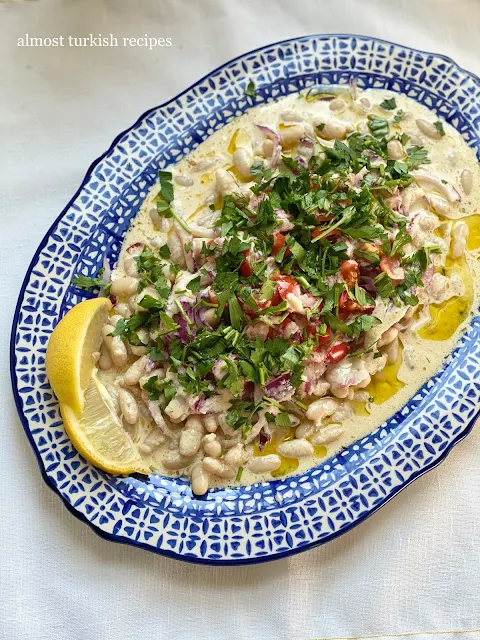
Piyaz is what we call bean salads in Turkey, but the term is actually Persian and means "onion." Piyaz is usually prepared with cannellini beans and kneaded onion; dressed with olive oil and vinegar; spiced up with pepper flakes; and decorated with tomatoes, parsley, and hard-boiled eggs. Depending on the region, piyaz might have green onions or sumac. However, in Antalya, a beautiful city with magnificent beaches and  rich history on the Mediterranean coast, piyaz is made differently than the rest of Turkey. The difference is tahini and garlic, which had put me off at my first try because it was so different and incredibly rich than the piyazs I was used to. In Tekirdag, my hometown, and in Antalya piyaz is usually served with grilled meatballs. 

I've had different versions of Antalya bean salad in years. Sometimes the difference is how it's served; with or without onions, sometimes it's the beans; sometimes the beans are served warm and sometimes at room temperature; and sometimes it's the sauce; some add smashed or pureed beans to the sauce, some add a little bit of sugar to level the tahini, and some add cumin, which I liked a lot. This is how I make my Antalya bean salad at home to go with grilled meatballs.  

2 cups of cooked cannellini beans (save the cooking water)
1 small onion, cut finely in julienne or half-moons (in Antalya, they serve the onion diced, but I prefer julienne)
1/2 cup parsley, finely chopped
1 or two hard boiled eggs, sliced or grated (I don't like eating cold eggs, so I skip this one)
1 tomato, peeled if you feel like it and diced


the sauce
1/2 cup tahini
4 tbsp vinegar, red wine or apple
Juice of half a lemon 
2 cloves of garlic, minced
1/4 - 1/3 cup olive oil
1tsp salt
1/2 tsp ground cumin, if you want to try it with cumin 


-Soak the beans overnight. Bring them to a boil and then on medium heat cook them until soft but never mushy, they should be holding themselves fine. Save the cooking water. OR, ofcourse, use canned beans.
-In a bowl mix first tahini and vinegar to a smooth consistency. It will get clumpy; it's fine, it will loosen up. Just keep stirring. 
-Add minced garlic, salt, and garlic. If the sauce is thick, this is where we will add the cooking water from beans, a couple of tablespoons at a time, slowly. Use a whisk to get rid of clumps. Add water until you have a smooth tahini sauce, but not very runny. The tahini sauce shouldn't be too runny or thick. Since different tahini brands have different density, I cannot tell you exactly how many tablespoons of water you need. Finally add lemon juice and half of the olive oil and whisk again. 
-First place the beans on a plate (I like the warm bean version so I keep the beans in the pot until I serve them to keep them warm). In Turkey piyaz is usually served on oval, slightly deep serving platters so you have enough sauce to dip your crusty bread in.
-Slice the onion thinly julienne style and knead with 1 tsp salt in a bowl. Rinse and squeeze the excess water and place on the bean. 
-Add diced tomatoes on top.
-This is where that boiled egg will come. You can add the egg chopped or grated on top. 
-Pour the tahini dressing over everything on the plate evenly.
-Sprinkle finely chopped parsley on top of everything.
-Finally, dress with the rest of the olive oil and serve with a lemon slice or half a lemon on the side, because there's no such thing as piyaz being "too sour."  Piyaz is usually tossed at the table and you have to, have to soak that juice with bread! 


Vegetarian and Minty Cannellini Beans (Zeytinyağlı Naneli Kuru Fasulye)


Cannellini beans, referred to as dry beans or simply as 'the dry,' along with rice is THE traditional Turkish dish. If there's pickled vegetables on the side, especially cabbage, voila, jackpot!  There are variations of this recipe based on what kind of meat you want to use, or although rare, a vegetarian version. You can cook dry cannellinis  with stew beef or lamb, with ground meat-my least favorite, pastrami (pastirma)-yumm, and/or soujuk (sucuk, Middle Eastern/Turkish sausage). 

Although traditionally the dish has meat in it, growing up in my house we loved the 'olive oil! i.e. the vegetarian version the best, especially during summers. Mom's vegetarian summer version has no meat but sweet green chilies, fresh mint leaves, and sun dried tomatoes. Delicious! 


For 4 people
2 cups soaked cannellini beans (1 cup soaked overnight makes ~2 cups) or 2 cans of cannellini beans [Although the taste will be different, you can use northern or navy beans as well]
1 medium onion, finely chopped
2 cloves of garlic, chopped finely
2-3 sweet green chilies or any peppers you like or can fine, chopped 
1/3 cup fresh mint leaves, finely chopped or 1-1 1/2 tbsp dry mint leaves
1/3 cup or more sun dried tomatoes, chopped
1 tbsp tomato paste
1 tomato, grated or canned petite diced tomato
salt 
3-4 tbsp olive oil

-Put olive oil in a cast iron pot and heat [You can use any kind of pot, but beans are cooked best in cast irons or clay pots]
-Add onion and cook ~5 minutes until soft but not brown.
-Add green peppers and cook 2-3 minutes.
-Add garlic and tomato paste. Cook for 2 minutes. 
-Add beans, sun dried tomatoes, fresh or dry mint leaves, and grated tomato. Cook for 2 minutes.
-Add water to go almost an inch over the beans. Salt to your taste.
-Bring to a boil and then simmer covered on low to medium for 30-40 minutes. If you're using canned beans 30 minutes will be enough. If you soaked the beans overnight, check the beans after 40 minutes; they may need a good hour or bit more. 
-Enjoy with rice or any kind of grain on the side or crusty bread to soak that delicious tomato juice. Yogurt and pickled veggies on the side are most beloved sides for dry beans. 


Turkish Style Fresh Borlotti (Cranberry) Beans (Barbunya Pilaki)


It is barbunya beans season, again! These delicious nutty beans with red or dark purple speckles packed with a long list of health benefits (google it!) are also called borlotti, cranberry, roman (not the Italian green ones), or October beans. In Turkey these reddish delicious beans are named after yet another red deliciousness: the Mediterranean red mullet, aka barbunya, from the Greek barbounia. 

Barbunya beans arrive at the farmer's markets in Turkey in midsummer, in pods, and when they do arrive they immediately become the most expensive item on the carts. Since people wait for their arrival for so long, at the time of their arrival they’re ready to pay whatever—it’s definitely a seller’s market. By the end of the summer and end of the barbunya season, however, barbunya stocks start to go down and barbunya lovers invest in kilos and kilos of barbunyas. They pod them and keep them in the freezer for the long barbunya deprived winter. Although you can find dry barbunyas year around, fresh barbunyas are always, and I cannot emphasize this enough, always preferred to dried ones.


Barbunyas are always cooked the same way in Turkish cuisine, i.e. vegetarian, in generous amount of olive oil with tomatoes. Cooked in any other way, it’s considered a pity, a total waste. “The” barbunya dish, the Istanbul style, is called barbunya pilaki. The word pilaki also comes from Greek (remember “gigantes plaki”?) and in its Turkish form, the word is a generic name for a dish of vegetables or seafood slowly braised with onion, garlic, and tomatoes in olive oil and served cold or at room temperature. However, although there are scrumptious seafood pilakis, the name in time happened to be associated only with bean pilakis, cannellini and barbunya, to be specific. This is my recipe for barbunya pilaki.

Barbunya pilaki is traditionally made with potatoes and carrots; however, I really do not like potatoes in this dish; I strongly believe that potatoes cloud the flavor of barbunyas. I replace potatoes for green sweet peppers, or in their absence, with sweat Italian peppers.

I usually cook barbunyas in pressure cooker, since it’s faster. You can use this recipe with regular or instant pots as well.

serves ~4
2 lb of fresh barbunyas in pod, pod them. Sometimes when they are very fresh, the pods are firm and hard to pod. If that's the case, leave them in a fabric bag for a day or two to breathe and loosen up. 
1 medium onion, finely diced
3 cloves of garlic, finely chopped or thinly sliced
1 potato, peeled and diced
OR, if you want to try my version 3-4 sweet green peppers, chopped in small pieces
1 carrot, cut in half or quarter moons
2 big tomatoes, grated or crushed in a food processor
1/3 cup olive oil, for starters and if you’re ready for it add a heaping tbsp more (we do believe in olive oil)
1 tbsp tomato paste (optional)
1 cup hot water
1 tsp sugar
2 tsp or more salt


-Pod all the beans. Your 2 lb fresh barbunya beans will diminish to ~1 lb once podded. They might come in different sizes and colors, all fine. Don’t be alarmed; they will loose their bright colors and turn brownish once cooked. Still, all good.
-Add olive oil in your pot and once warmed up add onions. Cook for 4-5 minutes on medium to high heat until softened.
-Add sugar, garlic, peppers or potatoes, and carrots, and cook for 2-3 minutes.
-If you think your tomatoes won’t give a vibrant red color, which happens a lot, you can use tomato paste. If so, add it now and cook for a minute.
-Add barbunyas and tomatoes, and stir for a minute or two.
-Add water and salt.
-If you’re using a pressure cooker, cover and cook on low after the steam comes out for 16-18 minutes. (I have a young clientele who like soft food, so I go for 18 minutes). If you’re using a regular pot, cover and simmer for 30-35 minutes on low until beans are cooked. Check now and then to make sure it doesn’t run out of water. If it does, boil some water before adding more.  
-Once it is cooked, let it cool down to room temperature in its pot with the lid on.

Barbunya pilaki is a traditional olive oil dish and like all olive oil dishes it is served at room temperature or cold, with lemon slices. A splash of lemon juice brightens up barbunyas in unimaginable ways. Serve with grilled meat, with rice on the side or with crusty bread. It’ll keep in the fridge for a week.


Fava Bean and Pea Salad (İç Bakla ve Bezelye Salatası)


A timely, deliciously green olive oil dish or salad for spring when both fresh fava beans and peas start to appear at farmers' markets.

1 small onion, finely diced
1 clove of garlic, minced or finely chopped
1 lb fresh fava beans in pod (or frozen podded favas)
1/2 lb fresh peas in pod or frozen peas
3 green onions, finely chopped
~1/4 cup finely chopped fresh mint leaves
~1/4 cup finely chopped fresh dill
1/4 cup + 2 tbsp olive oil

1/2 tsp white sugar
juice of half a lemon

~1/3 cup crumbled feta (optional)
dressing


-Pod and boil fava beans in salted water for 5 minutes. The cooking time depends on the freshness of the beans. Blanch and poke the skin to squeeze the beans out. This is time consuming, yet makes a salad better. Some people find fava skins to be bitter, I don't. If anything skins make the salad a bit chewy and that is fine. I sometimes leave the skins on and sometimes, when I'm not in a rush, peel them.
-Heat a pot on medium, add 1/4 olive oil. When heated add onions. Cook onions on low to medium, do not brown them, until soft: 5-7 minutes.
-Add sugar, half of the chopped green onions, fava beans, and podded fresh or frozen green peas, and garlic, salt.  
-Cover and simmer on low for 15-20 minutes.
-Turn it off, add lemon juice, half of dill and mint and let cool down to room temperature in the pot, covered.
-Take the favas out on a serving plate. Sprinkle with the remaining green onion, dill and mint.
-Drizzle 2 tbsp of olive oil and serve at room temperature.

There's absolutely nothing written in stone; you can use more or less of anything, or add other herbs that you think would suit the favas and peas. I like sprinkling some white/feta cheese on top. 

Green Lentils (Yeşil Mercimek)


The eastern Thrace is the north western or the European part of Turkey. The region (except for Istanbul) is mostly occupied by people who migrated from the western Thrace (Greece and Bulgaria). Most of those people, like my grandparents, settled down in the region after the 1924 population exchange. This green lentil dish is cooked widely in eastern Thrace and known to be a western Thracian recipe.

1 cup dry green lentils
3 tbsp olive oil or butter
1 big onion, chopped
1 tbsp flour
2 tbsp tomato paste
salt
pepper
2 tbsp fresh dill, chopped

sauce
1/4 cup vinegar
2 cloves of garlic, minced
1 tsp red pepper flakes
or
use a vinegar based hot sauce


-Cook 1 cup green lentils with 3 cups of water on medium until water is completely soaked.
-In a different pot heat the oil and stir in onions. Cook until soft.
-Add flour and stir for a couple of minutes.
-Add tomato paste and stir for another couple of minutes.
-Add lentils with 2 1/2 cups of water. Salt to your taste. Cook on medium low for 30 minutes. -Add dill after you turn it off.
-For the sauce, in a little bowl mix 1/4 cup vinegar, 2 cloves of minced garlic, and crushed pepper.
-When you serve the lentils, put a couple of spoons of the sauce on lentils.
-Serve with bread or rice.

Red Lentil and Beet Soup (Kırmızı Mercimekli Pancar Çorbası)

This deliciously colorful and healthy soup is known simply as the "pink" soup in our house, since I prefer not to disclose to my young and picky eaters all the vegetables that goes in this soup: ignorance is bliss sometimes. This red lentil and beet soup is a staple in our house. Beets go into the soup and beet greens into this recipe.


2 small to medium size beets, peeled and diced (If bought in a bunch, use stems and leaves as well, chopped)
1 small red onion, chopped
3 cloves of garlic
1/2 cup red lentils, washed
1 to 1 1/2 cups of chopped fresh tomatoes or 1 can diced tomato
1 red bell pepper or 3 red sweet Italian peppers, chopped
4-5 cups of water (or vegetable or chicken stock)
2 tbsp olive oil
1 bay leaf
salt and pepper

for decoration
White/feta cheese
parsley, finely chopped

-Put all the ingredients in a big pot and bring to boil.
-Once it boils, turn the heat down and simmer approximately for 20 minutes or until everything is thoroughly cooked.
-Smoothen the soup with a hand blender. (If you don't have a hand blender, chop everything tiny or grate everything before adding them into the pot.)
-Optional: Serve with chopped parsley and white cheese on top (I also like to add a dollop of yogurt) and/or white crusty bread.

Fava Beans à la Turque (Zeytinyağlı İç Bakla)


Fava beans, also known as faba, broad, Windsor, or horse beans, are among the oldest cultivated plants. They've been grown and eaten across the Middle East, Europe, and South America for millennia, yet they took their sweet time reaching American markets. I didn't eat a single fava bean for the first 25 years of my life, which, in resrospect, was a real loss! In my defense, my mom cooked them in pod, in those slightly fuzzy pods that, to a child, looked alarmingly like caterpillars. I'm still not convinced about the pods. The shelled beans, however, are a different story. 

Fava beans are slightly sweet with a mild, grassy flavor that feels made for spring. In Turkey, when picked young and tender, they're cooked in the pod and served with a generous dollop of garlicy yogurt on the side. When picked a bit later, once the shells and beans have grown larger, they are shucked and the beans are peeled to remove the waxy outer coat. Shucking goes quickly; peeling takes a little patience, but it's entirely worth it. What follows is a traditional Turkish springtime olive oil dish recipe for fava beans.

serves four
  • 1 pound fresh fava beans, shelled and peeled, or 1 pound frozen fava beans (widely available at Middle Eastern markets)
  • 1 small onion, finely chopped
  • 2 cloves of garlic, minced 
  • 1/2 bunch of green onions, finely chopped
  • 1/2 bunch dill, chopped, plus more for serving
  • 1 tsp white sugar
  • 1 tsp salt, or a little more to taste
  • 1/3 cup olive oil, divided
  • 1 cup water
  • 1 tsp flour
  • juice of half lemon

-In a bowl, whisk together the water, flour, and lemon juice. As you peel the beans, drop them directly into this mixture to prevent browning. (If you blanch the beans in boiling water for 30 seconds first, the skins slip off much more easily.)
-Heat half of the olive oil in a pot over medium heat. Add the onion and cook until soft and translucent, without letting it color--browning is one unforgivable offense in olive oil dishes.
-Add the sugar, green onions, and garlic, and cook for about one minute until garlic is fragrant.
-Add fava beans along with their soaking liquid.
-Season with salt and add more water if needed to just cover the beans.
-Bring to a boil over medium heat, then reduce to low and simmer for 15-20 minutes, until the beans are tender.
-Remove from heat, cover, and let the dish cool in the pot before transferring to a serving plate.
-Like all Turkish olive oil dishes, this is best served at room temperature or cold.
-Drizzle the remaining olive oil over the top and finish with fresh chopped dill.

Serve with crusty bread and garlicy yogurt son the side.

Garlicy Yogurt
For every cup of yogurt, use half a clove of minced garlic as a starting point. adjusting upward if you like it stronger--though one clove per cup is a reasonable ceiling, as the people around you will have opinions about this. Mix well, season with salt, and serve alongside or spooned over the fava beans.

Roasted Beet Hummus (Pancarlı Humus)


In my first couple of years in the US, I couldn’t get over how popular hummus was in this country. I was surprised because hummus had managed to become popular despite how it was prepared and served: dense in texture and bland in flavor. It wasn’t anything like how we prepare and serve it—and Turks are not even the masters of it. Back home hummus is soft and airy in texture; light, lemony9, and spiced in flavor. It is served in shallow plates, never in deep bowls. You cannot be parsimonious with lemon juice, water, and olive oil; a good hummus needs them.

My experimentations with hummus have a lot to do with having kids. Realizing what a nutritious, not just delicious, snack it was I started adding or hiding colorful vegetables in hummus. Beets are just one of them and absolutely our family favourite. 


1 small to medium beet root
1 ½ cups cooked check peas
2 tbsp tahini
Juice of 1-1 ½ lemons
1-2 garlic cloves, minced
¼ cup yogurt
Salt
4 tbsp olive oil (3 in and 1 for the top)
Water (even better cooking water from the chickpeas) as necessary

Optional
Paprika
Cumin
Sesame seeds
Nigella seeds
Parsley

-The Beet: Wash well and then cut the bottom and top parts of the beet root. Cut the beet into four or, if it’s a big one, 8 pieces. Toss with a little bit of olive oil, place on a parchment paper and bake for 45 minutes in a preheated oven at 400F. (Do not discard the stems and leaves if they came with those. Try this beet greens with olive oil recipe.)
-The Chickpeas: I always buy chickpeas in bulk, soak them in water overnight, and then boil them until cooked for 1-1 ½ hours. It is best to use them right when they’re warm since the skins will be soft and easy to be smoothened by the blender.

Most authentic way of making hummus requires peeling the skins off. I find it very time consuming and have figured out an easy way out; If you are using canned chickpeas, put them in a pot with water and boil for 5-10 minutes to soften the skin.

I take what I need and freeze the rest of the chickpeas in jars filled with 1-2 cups for later use.

-Put tahini, olive oil, and lemon juice in the blender and run until smooth.
-Add the beet (~1 cup) and blend.
-Add chickpeas, yogurt, and salt.  
-Add water to thin. Humus should be soft and fluffy. It most definitely should not be like a paste.
-Taste and add more lemon juice, salt, or water.
-Ways to serve: Hummus is usually served in a wide shallow bowl in Turkey, never in a dip bowl. For regular hummus, we usually heat 1-2 tbsp olive oil in a small pan. When it’s hot, before it burns, we add paprika and let sizzle for 5 seconds. Then pour it over the hummus on its serving plate. Chopped parsley is another way to serve it. Some people like to drizzle olive oil and sprinkle cumin powder on top—this is my least favorite. I like to serve beet hummus with chopped parsley or dill on top or with sesame or nigella seeds. All is delicious.
-Traditionally, hummus is scooped with bread/pita bread; however, it’s good with pita chips, crackers, and fresh vegetables.