Almost Turkish Recipes

Showing posts with label roots. Show all posts

Sautéed Spicy Beet Greens


Beet greens, stems and leaves, although usually discarded, are in fact quite healthy, sweet, and delicious when cooked in simple ways. There are a couple of different ways of cooking beet greens in Turkish cuisine. The following recipe is a simple one rice and olive oil.

We get beets, red or golden, from the csa farm box almost every week and absolutely love to use them to pickle or for salads and risottos. I save the greens for my lunch.  I love sauteing them a couple of different ways like this recipe, but this spicy one with jalapenos is my favorite. 


beet greens of 1 bunch red or golden beet, stems and leaves chopped
1 small onion, finely chopped
2 cloves of garlic, minced
1 or more jalapenos or any hot pepper of your liking, finely chopped
2-3 tbsp olive oil
Salt and pepper
Red pepper flakes    


-Heat olive oil in a pot.
-Add onion and cook on medium 3-4 minutes until soft.
-Add beet stems, jalapeno, and garlic. Sauté another 3 minutes.
-Add chopped leaves, salt and pepper and keep sauteing on low to medium for ~10 minutes. 
-Salt and pepper to taste. Add hot pepper flakes if you wish.
-Serve at room temperature or cold, preferably with yogurt on top, and baguette on the side. Sprinkle with red pepper flakes and Tabasco sauce for more fun!

Potato Salad à la Turca (Patates Salatası)

https://drive.google.com/uc?export=view&id=1grSd9b2XK7LPle_kQW_udqGDdj-I7btd
Potato salad, I had to say à la Turque not to have it confused with any of its American or European cousins, is an herbed filled, green heavy savory deliciousness. It is a great side when grilling and the absolute perfect lunch on summer days. The history of this salad in Turkish cuisine is vague and it is made in differing variations across Turkey. Although potato salad is in all its variations usually prepared as quite savory and herby, it is rarely as herby as the one I make. This salad can be one of my earliest specialties as I started making at at the age of 10. My rule is any herb and any Mediterranean green can and must go into this salad. There's nothing written in stone here; you have your boiled potatoes and herbs on them. However, the Turkish potato salad has to be savory and a bit on the sour side.

Potatoes enough to make 4-5 cups when chopped--in Turkey this is made with yellow potatoes since we don't have red ones over there; however, I love it with red potatoes,too.
1 small onion
1/2 bunch green onions, chopped
1 cucumber, cut in quarter rounds
3 banana peppers (or any other green/red pepper), chopped finely
1/4 cups halved and pitted green olives
1/4 cups finely chopped dill pickles or capers
1/2 bunch parsley, chopped
1/4 cup dill, chopped
1/4 cup fresh mint, chopped or 2 tsp dried mint flakes
1/2 tsp spicy red crushed pepper (optional)
1 tsp sweet paprika
1 tsp sumac 
1/2 tsp black pepper
juice of one and a half lemons (check after one to see if it's sour enough for you. I usually end of using almost 2 lemon for their juice, but I do love sour)
1/3-1/2 cup olive oil, you will be surprised how much olive oil this salad can need and hide
1-2 tbsp dijon mustard (optional)
salt

-Either boil the potatoes (however much you will be using) as a whole in plenty of water until soft but not mushy, very important! You want the potatoes to hold their shapes. Then peel and dice them. (InTurkey potatoes are always peeled, but in Turkey potatoes usually come with a big chunk of the field they were planted in. I don't think the ones you find here in US need peeling. I prefer not peeling them) If you're short for time, peel (optional, again) and dice first and then boil them--this way they will be ready much faster, approximately 10 minutes. Drain and let cool
-Cut the onion in half lengthwise and then chop it into very thin half moons. Put the chopped onion in a bowl and knead it with 1 tsp salt until the onion is soft. Rinse the salt off the onion and drain. 
-Mix olive oil, salt, and lemon juice (and mustard if you choose to use it--it contributes to the savory taste in a magnificent way.)
-Mix all the other ingredients and potatoes in a big bowl. 
-Dress and mix well. Make necessary adjustments: olive oil, salt or more lemon juice. 

Serve as an appetizer, salad, as a side dish for meat or enjoy it as lunch on a hot summer day. 

Carrot Salad with Yogurt (Yoğurtlu Havuç Salatası)


Carrot salad with yogurt is one of the greatly respected rakı companions. Although it is made at homes not so frequently, usually for big dinner parties or special occasions like New Year's eve or bayram dinners, it is a  staple meze (appetizer/starter/hors d'oeuvre) at every pub that serves rakı, especially at seafood pubs. Surprisingly carrot salad with yogurt tastes even better at sloppy pubs with crusty bread and rakı than it does at home, probably because rakı fixes every imperfection. You can have this salad/meze on the side of any grilled goods or have it on its own for lunch on hot summer days.


serves 2 to 3 people
4 cups of grated carrot
1 cup plain yogurt, preferably whole milk yogurt
1-2 cloves of garlic, minced
2 tbsp olive oil
3-4 tbsp finely chopped fresh dill or parsley
salt
1 tbsp mayonnaise (optional)

-Heat oil in a skillet and add grated carrots. Stir until carrots are wilted.
-Mix yogurt, garlic, and salt in a bowl.
-Put carrots in a bowl and mix well with yogurt and sprinkle with dill or parsley.

note: At people's houses this meze is made with yogurt, but at pubs they sometimes use mayonnaise to thicken it up.

Red Lentil and Beet Soup (Kırmızı Mercimekli Pancar Çorbası)

This deliciously colorful and healthy soup is known simply as the "pink" soup in our house, since I prefer not to disclose to my young and picky eaters all the vegetables that goes in this soup: ignorance is bliss sometimes. This red lentil and beet soup is a staple in our house. Beets go into the soup and beet greens into this recipe.


2 small to medium size beets, peeled and diced (If bought in a bunch, use stems and leaves as well, chopped)
1 small red onion, chopped
3 cloves of garlic
1/2 cup red lentils, washed
1 to 1 1/2 cups of chopped fresh tomatoes or 1 can diced tomato
1 red bell pepper or 3 red sweet Italian peppers, chopped
4-5 cups of water (or vegetable or chicken stock)
2 tbsp olive oil
1 bay leaf
salt and pepper

for decoration
White/feta cheese
parsley, finely chopped

-Put all the ingredients in a big pot and bring to boil.
-Once it boils, turn the heat down and simmer approximately for 20 minutes or until everything is thoroughly cooked.
-Smoothen the soup with a hand blender. (If you don't have a hand blender, chop everything tiny or grate everything before adding them into the pot.)
-Optional: Serve with chopped parsley and white cheese on top (I also like to add a dollop of yogurt) and/or white crusty bread.

Sunchokes in Olive Oil (Zeytinyağlı Yer Elması)


This ginger look-alike, hard-to-peel root has many names in English among which I like sunchoke or sunroot the best. I liked the sun in those names but never really understood why a root that probably never sees the sun has that name, but then I saw the plant; it looks like, I thought, sunflower, and to my surprise it apparently is related to the sunflower plant. It is called yer elması, i.e. "earth apple," what French call potato, in Turkish.

Sunchokes, although not very common Turkey-wide, are very common in the Aegean and in Istanbul. The sunchoke season here in Northern California and in Turkey run from late November to to early Spring, and you can find them in stores and at farmers' markets. They are great in Turkish olive oil dishes (here's a recipe with orange juice) or raw in salads. This low in calorie, high in fiber root is quite rich when it comes to health benefits. It has a distinct sweet rooty and slightly nutty flavor, but it is not for everyone. I'm the only one who likes it cooked in my house. So you need to try and see whether you like it simmered in olive oil or raw, or like it at all. Below is a very traditional olive oil dish recipe.


serves ~4 people
1 lb sunchokes, peeled and left as a whole or diced
1 lb baby or regular potatoes
1/2 lb pearl onions peeled or one medium onion, finely chopped
2 medium carrots, diced or halved or 1 cup baby carrots
1/3 cup olive oil (yep, it is an olive oil dish and the amount is normal)
1/2 tsp sugar
salt
1/2 bunch fresh dill
juice of 1 lemon
1/4 cup water

-The hardest part of the recipe; peel the sunchokes. It is easier to peel them when left in water for 20-30 minutes beforehand. Leave them as they are or dice them.
-Put olive oil in a medium size pot on medium heat.
-When heated add pearl onions and sugar. Stir for 4-5 minutes until softened. Do not let them brown.
-Add sunchokes, carrots, potatoes, and half of the dill bunch, unchopped, for flavor.
-Stir for a minute.
-Add water, lemon juice, and salt.
-First let it boil, and then simmer it on low heat covered for 30-40 minutes, until cooked. If unsure, pierce sunchokes with a knife.
-Let the dish cool down in its pot with the lid on. Transfer to a serving plate only after cooled down.
-Serve with finely chopped fresh dill on top.

*This is an olive oil dish; it should be served at room temperature or cold. Olive oil dishes tend to taste even better the next day.

*I do like sunchokes in olive oil in round shapes, but you can cube or dice all the ingredients. It's just a matter of presentation.


For a non-traditional, or an almost Turkish, twist try with a splash of balsamic vinegar.


Pickled Beets (Pancar Turşusu)


Pickled beets is one of the easiest and, at the same time, the most delicious pickled vegetables of Turkish cuisine. It is considered one of the indispensable mezes of the Turkish raki tables. It is also good with hearty winter dishes such as legumes.


1 bunch beets = ~2lb beets = 3-4 medium size beets
1 tsp salt
11/2  tsp sugar
1/2 cup vinegar (red wine, apple, etc)
3-4 cloves of garlic, sliced

-Wear a dark color shirt or a very old one and put on an apron, beet stain is "the" toughest of all.
-Cut the tops and bottoms of beets and wash them really, really well.
-Place in a pot, cover with water, and cook until soft. (if a knife can go though them easily, then they're cooked.) This may take more or less 30-40 minutes. If you prefer a pressure cooker, set the timer for 15 minutes.
-Once they cool down, peel the beets (which is super easy once they're cooked) and preserve the cooking juice.
-Cut the beets the way you like; you can cube (as in the picture); slice; or halve them.
-Layer beets, garlic, vinegar, salt, and sugar in a glass jar. (To give you an idea three medium size cubed beets fit in an Atlas jar.)
-Fill the jar with preserved beet juice. Close tight and refrigerate.
-It's ready to eat the next day; no need to wait for longer.


Baked Halva with Carrots (Güveçte Havuçlu Helva)

A couple of years ago there were quite a number of fisherman boats tied at the Yenikoy coast in Istanbul serving as seafood restaurants. Although those floating restaurants had limited menus, they served the freshest and by far the cheapest seafood, the best salads (especially Tuana), and surprisingly simple yet delicious desserts (Takanik was the #1 when it came to desserts). All those boat restaurants moved tot the land after the ban; they're all still in Yenikoy, but in buildings in stead of boats. In the past years I tried different types of halva based desserts on these boats and loved them all. Normally I don't eat halva and this should give you an idea about how good their halva desserts are. I had purchased a box of Koska pistachio halva months ago from the Turkish market in Atlanta, for whom or what I have no idea. When I saw it in the pantry I decided to make one of the floating restaurants' halva desserts. The dessert was great, but it definitely lacked the preceding fish platter served on the boats. Although it is hard to find horse mackerels, halva is highly common here in the States in Middle Eastern markets or online.  

for two people

two 1" halva slices--use one slice per person (I used pistachio halva, but you can use plain, coco, or any kind)
1 carrot, grated
1 tsp lemon juice
cinnamon
2 tbsp ground pistachio or walnut 

-In an oven safe small bowl (a small souffle bowl) place a slice of halva. Make it as thick or thin as you wish.
-Squeeze a couple of drops of lemon juice on top: approximately 1/2 tsp.
-Cover halva with grated carrot; not too much, just enough to cover halva ~approximately 1/2 cup
-Sprinkle cinnamon on top.
-Cover the bowl with aluminum foil and bake for 15-20 minutes in preheated oven at 380F.
-Serve hot with ground walnut or pistachio on top.

-If you don't have a oven proof bowl, you can layer everything on a square aluminum foil, wrap it by bringing the corners together, and bake like that.    

Beet Salad with Yogurt (Yoğurtlu Pancar Salatası)


A popular appetizer / meze for Turkish brandy, rakı and red meat, and a very common winter salad.

2 medium size beets
1 cup yogurt (better to use strained yogurt)
1 clove of garlic, minced
1 tbsp olive oil
1 tbsp finely chopped dill or 1 tbsp basil flakes
salt and vinegar to taste

-Wash beets well, cut the stems, and boil them for ~25-30 minutes until cooked.
-When they cool down, peel and grate them. (While doing so, use an apron and gloves if you wish and don't wear white)
-Beat garlic, yogurt and olive oil in a bowl until smooth, and then mix with beets.
-Season with salt and vinegar

-Sprinkle dill or basil on top.
-Serve with bread, pita chips and / or as a side for red meat dishes.

Celery Root Rounds with Carrot (Havuçlu Kereviz Halkaları)


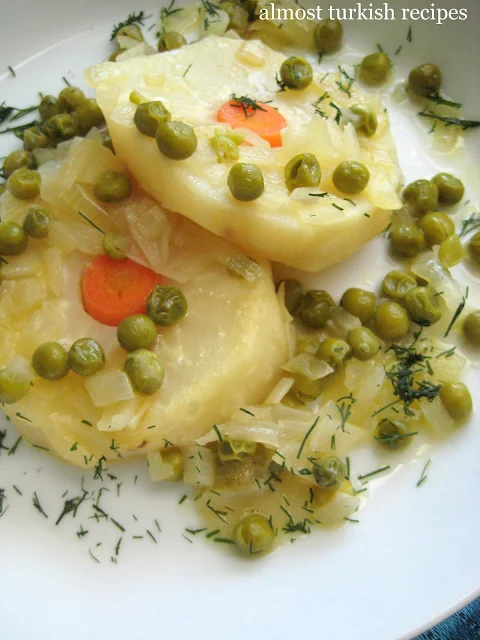
I had celery root rounds first at a tea-party in Turkey as one of the 7 or so dishes that the host prepared for an ~3 hour tea-party! Apparently the recent tea-party trend in Turkey is to impress your guests with the number and the presentation of the goodies you make. Mission accomplished; I was impressed by how much I could eat in 2 hours and with only Turkish tea as digestive. Another thing that impressed me was that although at first it seems like celery root rounds with carrot recipe is not different than regular celery root in olive oil recipe in terms of taste, cooking celery root in big pieces rather than diced form did actually contribute to the taste. So here we go: a good and actually very simple recipe if you like the distinct taste of celery root and one to wow your guests with.


for 2 people
1 medium size celery root
1 similar size potato
1-2 carrots
1 medium onion, diced
1 cup frozen or canned green peas
1 tsp sugar
1 1/2 tsp salt
1/4 cup olive oil
1 cup water
juice of 1 lemon
1/4 cup fresh dill, finely chopped


-Peel celery root and potato and core the middle big enough for the carrots you will use with a corer or the top part of your peeler.
-Put the carrots in the holes and cut extra parts.
-Place celery root and potato in a bowl of water with half of the lemon juice to prevent darkening.
-In a broad pot heat olive oil and saute onion until soft.
-Carefully cut the celery root and potato in ~half inch rounds.
-Push the onion aside in the pot and place celery root and potato rounds in the pot side by side.
-Put the onions on top.
-Add green peas, sugar, salt, rest of the lemon juice, 1 cup water and cook on a little below the medium heat for 25-30 minutes.
-Let cool in the pot with the lid on.
-Sprinkle with fresh dill and serve.

Celery Root Salad with Yogurt (Yoğurtlu Kereviz Salatası)


There are two common lies that Turkish moms tell their non-celery root liking kids. If celery root is cooked, the mom forces the dish as a potato dish. The different smell and taste? Oh, it's just the spice she used! However, if celery root is to be eaten raw, as in celery root salad with yogurt, then the kid is told that it is radish salad. I loved radishes as a kid and tried this so-called radish salad served on a New Year's Eve dinner, which is a big celebration in Turkey that includes lot of drinking, turkey, numerous raki friendly salads and olive oil dishes, bingo, several kilos of fruit, and a belly dancer that appears on every TV channel exactly at midnight.


1 medium celery root, thinly grated
juice of 1/2 lemon
thick yogurt
mayonnaise
chopped walnuts
salt
dill, finely chopped
1 clove of garlic, minced
1 tbsp olive oil

-Grate celery root in a bowl.
-Squeeze lemon juice on top and mix well.
-Add enough yogurt+mayo to cover grated celery root. The ideal ratio of mayo to yogurt 1:3, however, you can change it to adopt your taste.
-Add minced garlic, chopped walnuts, dill, salt, and olive oil. Mix well.
-Cover with a clear wrap and store in the fridge for at least two hours before serving.

Garbanzo Beans and Soft Wheat Berries Soup (Nohut ve Buğdaylı Çorba)


A hearty delicious soup for the last cold days of winter from Lezzet's February 2007 issue.

1 cup dry garbanzo beans
1/2 cup soft wheat berries
1/2 cup red lentils
1 small celery root/celeria, grated
1 carrot, petite diced
5-6 parsley stems, chopped
2-3 celery root stems, chopped
2 tbsp butter
2 small onions, finely chopped
2 tbsp tomato paste
6 cups vegetable or beef stock
2 tsp oregano leaves
1 cup plain yogurt (non-fat, 1%, 2%, or whole milk)
1 tbsp olive oil
salt
pepper


-Put garbanzo beans and soft wheat berries in a pot. Cover with water ~3 inches above garbanzo and soft wheat berries. Bring to a boil. Then turn it off, cover and soak overnight. Wash and rinse them well the next day.
-Heat butter in a big pot. Add onions and cook until soft.
-Add in red lentils and tomato paste. Stir for 2-3 minutes. Then, add soaked garbanzo beans and soft wheat berries. Stir for another 2-3 minutes.
-Add grated celery root, diced carrot, chopped parsley and celery root stems, oregano leaves, black pepper, salt, and stock (vegetable or beef).
-Let it boil on medium heat for approximately an hour.
-In a small bowl, mix yogurt and olive oil.
-Slowly stir yogurt into the soup. Mix once and let it boil for a couple of minutes. Then turn it off. The soup is ready.

Stuffed Onions (Soğan Dolması)


In order to promote circulation sales, once in a week most newspapers in Turkey come with a supplementary booklet loaded with recipes by TV celebrity chefs. Sad but true! Turkey has witnessed worse; in the past, newspapers offered even non-reading related "things" to increase their sales. Among those were vacuum cleaners, radios, TVs, dinner sets, silverware, cameras, bikes, etc. Unfortunately people subscribed for months to certain newspapers not for their content, political views, or their columnists, but for the items those papers were offering. Compared to TVs and plates, recipe booklets seem less harmless since you need to "read" those recipes.

My mom had packed a couple of food magazines and those recipe booklets when they came to visit us last April. One of the booklets is by a TV celebrity chef, Emine Beder whose dishes I usually find too greasy, and recipes unexciting. However, I have to give her credits; her measurements are very peculiar and when followed strictly, recipes turn out as expected--no surprises.

I found her recipes after the move while unpacking. Flipping through the pages, I found this jewel among ordinary recipes. I changed the recipe here and there, but remained loyal to it in principle. The result was magnificent. I think I will give her recipes another chance.


2-3 red onions (try to pick large ones--the recipe called for regular onions, I chose to use red ones)
1/3 lb ground meat (beef or lamb)

1/4 cup rice
1 1/2 tbsp butter

2 tbsp olive oil
2 tbsp tomato paste
2 tbsp red pepper paste (if you cannot find it, use tomato paste)
1/3 cup crushed dried sumac
1 tsp dried mint flakes
1 tsp oregano leaves
1 tsp cumin
1 tsp black pepper

1 tsp or more crushed red pepper flakes
1 cup hot water
salt

- Cut the bottom parts of onions 1/4 inch and peel.
-Boil them until soft, but not too soft. Rinse and let cool down.
-Squeeze each one to get every single layer. You will be stuffing those layers. If slippery, use a clean kitchen towel to grip and squeeze.
-Wash rice in plenty water and rinse.
-Soak sumac in hot water for 15 minutes and drain. Save the water.
-Heat butter in a frying pan. Add pastes, spices, and salt. Mix well and cook for 3-4 minutes.
-Take the pan off the fire. Add ground meat, rice, and sumac. Mix well.
-Stuff onions with the mix and place them in a broad pot.
-Pour in sumac water.
-After it starts boiling, simmer covered on low for half an hour.
-Serve hot with crusty bread. We loved it, especially with yogurt.

Vegetarian Potato Casserole with Green Lentils (Mercimekli Patates Oturtma)


Back in the 80s, when I was in the elementary school, to support farmers who couldn't sell their produce Turkish government had bought hard-to-melt-down amount of lentils. The government's solution for agricultural crisis created another problem: warehouses stocked with lentils.

Government's solution to this new lentil crisis was Ayşe Baysal, professor of nutrition and dietetics, aka "auntie Ayşe" or "auntie lentil." Auntie lentil appeared every single day, seriously, for months on TV, on the only channel of the time--the state's channel TRT1, and gave a lentil recipe. Behind this obsessive non-stop lentil recipe creation was, of course, the determination of government and auntie Ayşe to reduce the national surplus of lentils.

Turkish public learned from "auntie lentil" that 100 gr. lentils is equal to ? gr. ground meat; how to make phyllo dough pastries (börek) with lentils; or how to make dolmas with lentils. Some of these recipes inspired Turkish people to cook more with lentils, and some scarred us; they became a nation's nightmare or a part of its dark collective unconscious like "baklava with lentils"!! The idea annoys me to this day. (I wonder if anyone tried)

I remembered auntie lentil a couple of days ago when I wanted to make a traditional Turkish recipe, potato casserole, which requires ground meat. I am not really fond of ground meat and I was thinking about how or with what to replace it when I clearly remembered auntie lentil saying over and over again that lentils are perfect substitute for ground meat. And here we go...


1 cup green lentils
5-6 potatoes, cut in 1/2 inch rounds (This time I used red potatoes, but any potato is fine)
2 medium onions, finely chopped
2 cloves of garlic, minced
2 big red Italian sweet peppers or 2 green chilies, finely chopped
2 tomatoes, diced
2 tbsp tomato paste
1 cup chopped parsley
3 - 4 tbsp olive oil
1 tsp cumin
1 bay leaf
crushed red pepper flakes
ground pepper and salt

-Boil green lentils with 1 tsp cumin, 1 bay leaf, and 5 cups of water until cooked. Rinse.
-Boil potato rounds in salty water for approximately 10 minutes. Don't let them get mushy; they should be cooked but firm.
-Heat oil in a pan. Add onions and garlic. Cook for 5-6 minutes until onion is softened.
-Add peppers and cook for 3 minutes.
-Add tomato paste and cook for 2 more minutes.
-Stir in tomato and lentils. Add salt and pepper (and optional crushed red pepper flakes).
-Cover and simmer for 10-15 minutes. (Add a little bit of water if it dries out)
-Grease an oven dish and place potato rounds. Cover potato rounds with lentils. Pour 1/4 cup of water.
-Bake in a preheated oven at 350F for 20-25 minutes.
-Sprinkle parsley on top before you serve.

The recipe turned out really good. We tried it with yogurt the first day; we loved it. And next day we heated it up in the oven with cheese on top. That was delicious, too.

This lentil recipe with my favorite herb parsley is for "auntie lentil" as well as for Simona of Briciole, my favorite lexiconist food blogger who is hosting Kalyn's Weekend Herb Blogging.

Bulgur Risotto with Beet and Beer (Bira ve Pancarla Bulgurlu Risotto)


We've been obsessed with risotto lately. Once I got familiar with the ins and outs of making risotto, I felt like I gained the authority to explore with the "genre." I wanted to make an almost Turkish fall risotto. The recipe gets its Turkishness from bulgur, and its fallness from beet, beer, and walnuts.

I used Negra Modelo, a non-hoppy dark lager. I didn't want to bitter up the risotto with hops. Beets have somewhat sweet flavor that goes perfect with tarragon. This was one of the best risottos I've ever had and I'm not saying this because I made up this recipe.


1 1/2 cups coarse bulgur
1 cup Negro Modelo
4 cups of stock (I used vegetarian stock)
1 onion, finely chopped
2 cloves of garlic, minced
3 spring onions, chopped
1 cup of grated beet root
2 tbsp olive oil or butter
1 tbsp butter
1/2 cup Romano or Parmesan
1/4 cup feta cheese
1/4 cup finely chopped walnuts
2 tbsp tarragon
salt
black pepper


-Bring the stock to a boil and then turn it down.
-Heat the olive oil in a pot and stir in onion, garlic, and green onions. Cook until onions are soft.
-Add bulgur. Stir for a minute or so until bulgur is coated with oil and vegetables.
-Slowly add beer and and wait until it totally evaporates.
-Add in grated beet, tarragon, black pepper, and salt--be careful with salt if you're using already salty kinds of cheese. Stir for a minute or two.
-Start adding the hot stock into the pot 1/2 cup at a time. Simmer each 1/2 cup stock until absorbed, stirring frequently.
-Add cheese, walnuts, and 1 tbsp butter. Mix well. Wait for 5 minutes and serve.


With the perfect harmony of tarragon and beet, "Bulgur Risotto with Beet and Beer" is for Weekend Herb Blogging that was founded by Kalyn of Kalyn's Kitchen and is hosted this week by Truffle of What's on My Plate

Sunchokes with Orange Juice (Portakal Sulu Zeytinyağlı Yerelması)


This weird looking vegetable is north American; it's in the sunflower family. It was called "sun roots" by Native Americans, but for some unknown reason was named "Jerusalem artichoke" by a French man sometime around 1600s. It's nothing like an artichoke and it is not from or related to Jerusalem. In Turkish, we call it yerelması, which literally means "earth apple"; the same term that French use for potato, pomme de terre. In Italian, I learned, it is called girasole articiocco, sunflower artichoke, which through mispronunciation ended up as "sunchoke" in English.

As I said before, it tastes nothing like artichokes. I might say something between apples and potatoes with a slight touch of celery root; its taste is as complicated as its etymological history. Sunchoke cooked with olive oil and served cold is a specialty of the cuisine of the Turkish Aegean coast. I don't want to start listing all the health benefits of sunchoke; just know that it's really good for you in many ways.


Although this is a traditional Turkish recipe, I twisted it a little by adding orange juice. To make it "really Turkish" instead of "almost Turkish" just replace orange juice with water.

1 lb sunchokes, peeled and cut into strips
2 onions, chopped
2 cloves of garlic, sliced
2 medium potatoes, cut into strips
2 medium carrots, cut into jullien strips
2 tbsp rice
1/3 cup olive oil
3/4 cup juice of an orange
1 tsp sugar
1/4 bunch dill, chopped
salt

-Fill a bowl with water and squeeze half of a lemon. Put sunchokes and potatoes in water after chopping. Lemon juice will prevent darkening.
-In a broad pot, heat the oil. Stir onion and garlic until cooked.
-Add in first carrots, then potatoes, and last sunchokes. Cook for a couple of minutes stirring gently.
-Pour in orange juice, sugar, and salt.
-When it starts boiling, add rice.
-Cover and cook on low-medium until rice and vegetables are cooked--approximately 30 minutes.
-Let it cool down with the lid on.
-Sprinkle dill on top before you serve. You can also sprinkle orange zest.

This is a Turkish olive oil recipe which means it should be served cold. Try and you'll see; it's tastier when it's cold.

Potato Casserole (Patates Oturtma)


My parents and my aunt are here visiting. Among other things, they're cooking. The potato casserole is tonight's dinner and the recipe is from my aunt. I'll try to get as many recipes as possible while they're here and post them. Bon appétit!

2 pounds potatoes, peeled and cut in 1/2 inch rounds
2 medium onions, chopped
1/2 pound ground meat
2 carrots, cut in rounds
2-3 banana peppers or 1 green bell pepper, chopped finely
1 clove of garlic, thinly sliced
1 1/2 tbsp tomato paste
1/4 cup olive or canola oil
1/2 cup (or less) olive oil
salt and pepper


-Mix potato slices with salt and 2 tbsp olive oil and place them on a big oven dish and bake at 350 F until they darken to slightly brown.
-Heat the rest of the oil in a big frying pan. Stir onions and garlic until soft.
-Add peppers and carrots. Stir until cooked.
-Add ground meat. Stir until ground meat is cooked.
-Add tomato paste, salt, and black pepper. Stir for 5 minutes, pour in 1 to 1 1/2 cup of water and cook for another 5 minutes.
-In a oven dish put one layer of potatoes. Cover them with ground meat mix. On top put another layer of potatoes and again another layer of ground mix. Repeat this layering until everything is finished.
-Bake it in the preheated oven at 350 F for 15-25 minutes.
-Sprinkle parsley on top before you serve.

Celery Root à la Turque (Zeytinyağlı Kereviz)


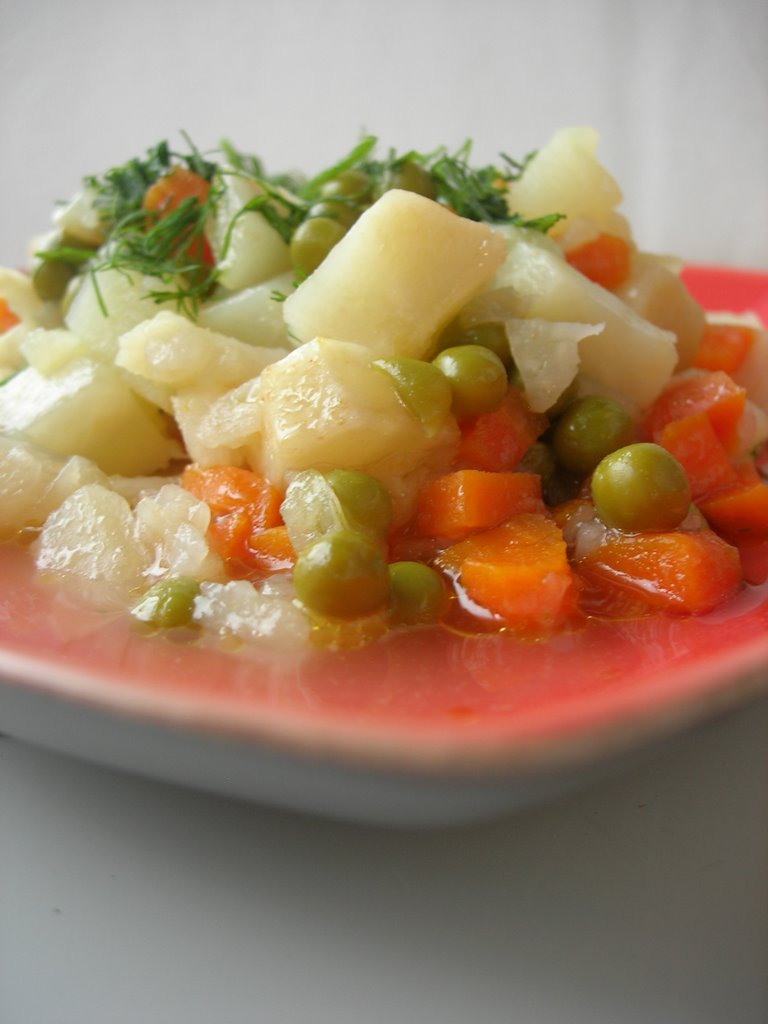
Who likes celery root? It's a complicated issue. People who think it has a very strong smell can handle celery stalks. And there are also people like me who cannot have even a single bite from celery stalk because of its smell, but love celery root. So you have to try to see if you like it or not. As if having one strong smelling plant is not enough, this recipe requires another one: dill, the odor of which, to some, is less agreeable than many other herbs like fennel or cilantro. Although some fictitious characters like Beavis and Butt-Head use "dillweed" as an insult, the term "dill" comes from an Anglo-Saxon word, dylee, that means to lull or soothe. Strong smells of celery root and dill create a perfect harmony. Celery roots usually look like this when they are not cooked:


1 medium size celery root, peeled and diced
1 big onion, diced
2 carrots, cut in quarter-rounds
1 potato, peeled and diced
1/3 cup olive oil
1 can of green peas (15 oz- 400 gr.) or frozen peas
1 tsp sugar
salt
1 bunch dill, chopped
water

-Pick a strong knife to peel and chop celery root; it's a little bit hard. And make sure among all the ingredients it's the last thing to chop. Peeled celery root darkens pretty fast.
-Put everything except for dill in a broad pot. Add water to barely cover the ingredients.
-Cook on low for 25-30 minutes. To see if it's cooked taste the carrots.
-Let it cool down. Garnish with dill.

This recipe of celery root is an olive oil recipe, and it is best when it's served cold. However, it's good when it's warm, too.


This is another dill recipe for Weekend Herb Blogging created by Kalyn and hosted by Haalo of Cook (almost) Anything at Least Once . Just like fava beans, to serve celery root without dill would be a crime.